
Day 30 is the most expensive day of a Thai holiday if you get it wrong. Extending your stay at an immigration office costs 1,900 baht and buys another 30 days — about $56, £43 or €51, which works out at 63 baht a day. Overstaying the same month costs 15,000 baht in fines, nearly eight times as much, and risks a five-year ban. The break-even between the two is four days.
Since 15 September 2026 the standard visa-free stay in Thailand has been 30 days rather than 60, so a deadline that used to fall after most holidays had ended now lands in the middle of plenty of them. This budget travel guide prices the four ways out of it — extend, fly out, cross a land border, or overstay — in exact baht, because these are the Thailand travel costs nobody puts in a spreadsheet before they fly. Figures were read on 24 November 2026. Conversions use mid-market Thai baht exchange rates at the 20 November close, when one US dollar bought 33.95 baht, one pound 44.45, one euro 37.26 and one Australian dollar 22.48.
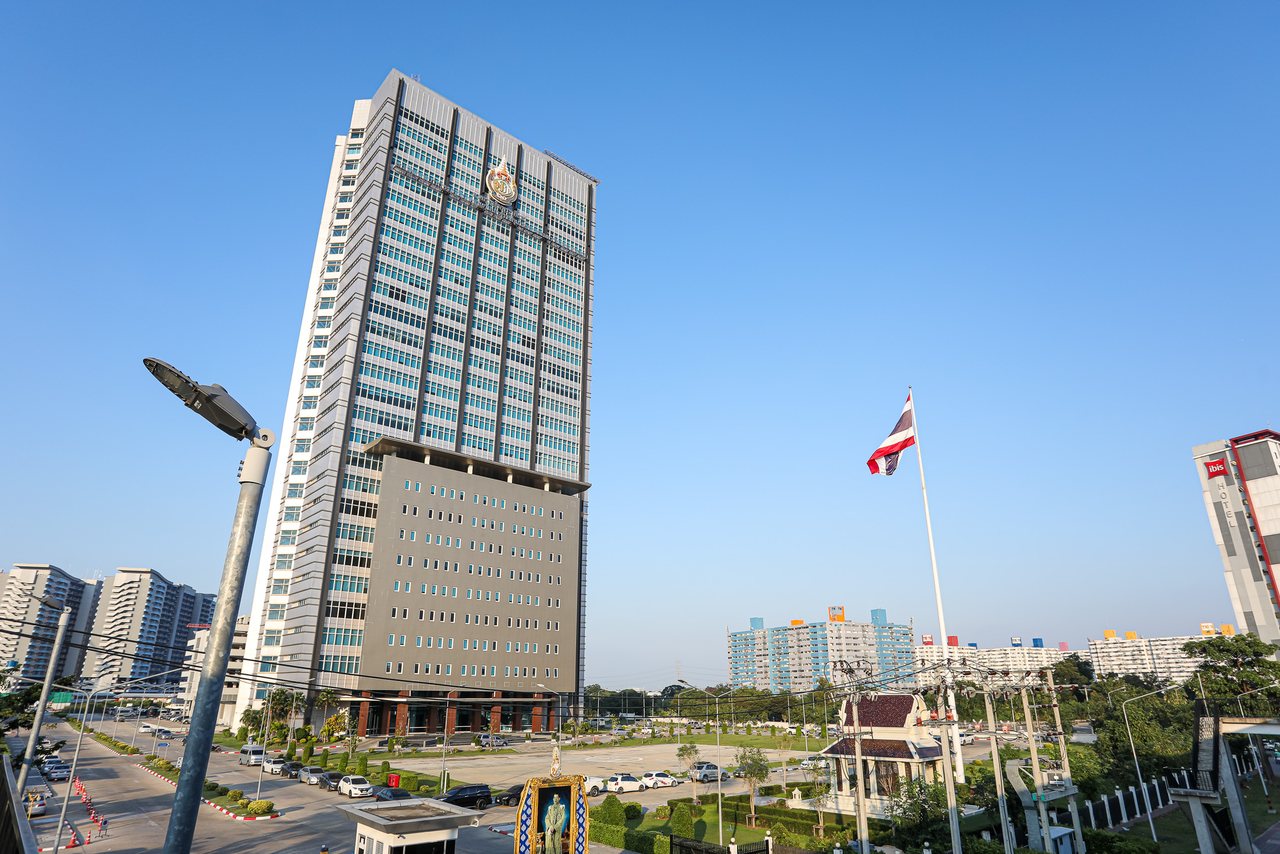
What day 30 is now, and who it catches
The Ministry of Interior announcements behind the change were published in the Royal Gazette on 31 August 2026 and took effect on 15 September. Passport holders from 60 listed countries and territories get a visa exemption for tourism of up to 30 days; Seychelles and Mauritius get 15. Entry under the exemption through a land border is generally limited to twice per calendar year, which does not apply to nationals of Malaysia, Brunei, Indonesia and Singapore. Visa on Arrival now covers only Azerbaijan, Belarus and Serbia, at 2,000 baht. The full picture is in our guide to the cut to 30 days.
The practical effect is a date stamped in your passport on arrival, and the only number that matters is the one in that stamp — not 30 days counted on your fingers, and not what a hotel receptionist tells you.
The 1,900-baht extension and the Thailand travel costs around it
A visa-exempt stay can be extended once, by up to 30 days, at a Thai immigration office, on form TM.7, for a fee of 1,900 baht. You need your passport, a recent photograph, copies of the passport and entry pages, and proof of your address in Thailand; local offices ask for more or less depending on the office and the officer, and approval is discretionary rather than automatic. You must apply before the stamped date expires, and there is no second extension — after that you leave, or you change to a different visa category.
The fee is not the whole cost, and the honest version of this budget travel guide prices the day around it.
| Item | Typical cost (THB) |
|---|---|
| TM.7 extension of stay fee | 1,900 |
| Passport photographs (a set at a photo shop) | 100–150 |
| Photocopies of passport and entry stamp | 10–20 |
| Transport, Bangkok: Pink Line monorail to Government Complex station | 15–45 each way |
| Transport, Bangkok: Grab or taxi from Sukhumvit instead | 250–350 each way |
| All-in, by rail | about 2,050–2,150 |
Call it 2,100 baht and half a day of queueing for 30 extra days: 70 baht a day, against an average cost per day in Thailand of roughly 1,500 to 2,500 baht for a mid-range traveller. It is the cheapest month you will buy on the whole trip. Go by monorail rather than car, incidentally — the Government Complex station on the Pink Line, open since January 2024, lists Immigration Division 1 among its exits.
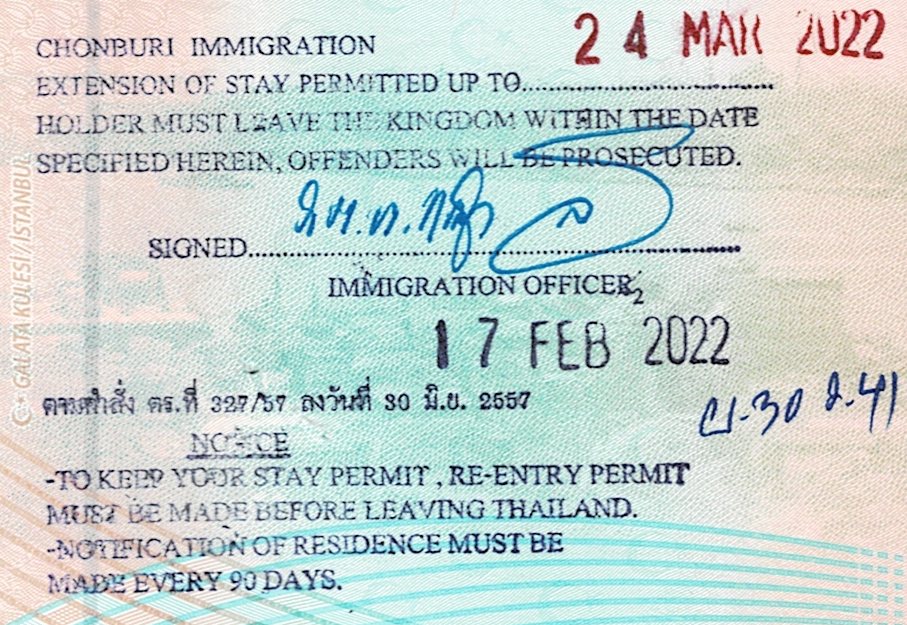
Thailand travel costs compared: extend, fly out, border run or overstay
| Option at day 30 | Cash cost (THB) | Per extra day | Time cost |
|---|---|---|---|
| Extend at an immigration office | about 2,100 | 70 | Half a day, once |
| Fly out and re-enter by air | 4,000–8,000 return on a regional low-cost route, including the 1,120-baht departure charge inside the fare, plus a night away | 130–270 | Two travel days |
| Land border run and re-enter | 1,000–1,600 in buses, trains and vans from Bangkok | 33–53 | Two long days; capped at two land entries a calendar year |
| Overstay for a month | 15,000 in fines at 500 a day | 500 | None, until it costs you five years |
Read the table properly. A border run is the only option that undercuts the extension in pure cash, and it does so by burning two days and one of the two visa-free land entries you are allowed in a calendar year. Price those two days at even a modest daily budget and it loses. The flight out is worse again: you are paying a 1,120-baht airport passenger service charge for the privilege, as our piece on the airport departure fee sets out, on top of a fare, a hotel night and the Suvarnabhumi airport transit at either end — 45 baht each way on the Airport Rail Link if you do it properly, several hundred if you take a taxi. For anyone already in Bangkok, Chiang Mai, Phuket or Pattaya, the immigration office wins on cash and on time.
The four-day break-even nobody calculates
Overstaying carries a fine of 500 baht for each day, capped at 20,000 baht — about $589 or £450 — which is reached at 40 days. Divide the 1,900-baht extension fee by 500 and you get 3.8 days. That is the whole arithmetic: from the fourth day of an overstay you have paid more than a legitimate 30-day extension would have cost, and you have bought nothing but a stamp in your file. Three days over is 1,500 baht; a fortnight over is 7,000; the month is 15,000.
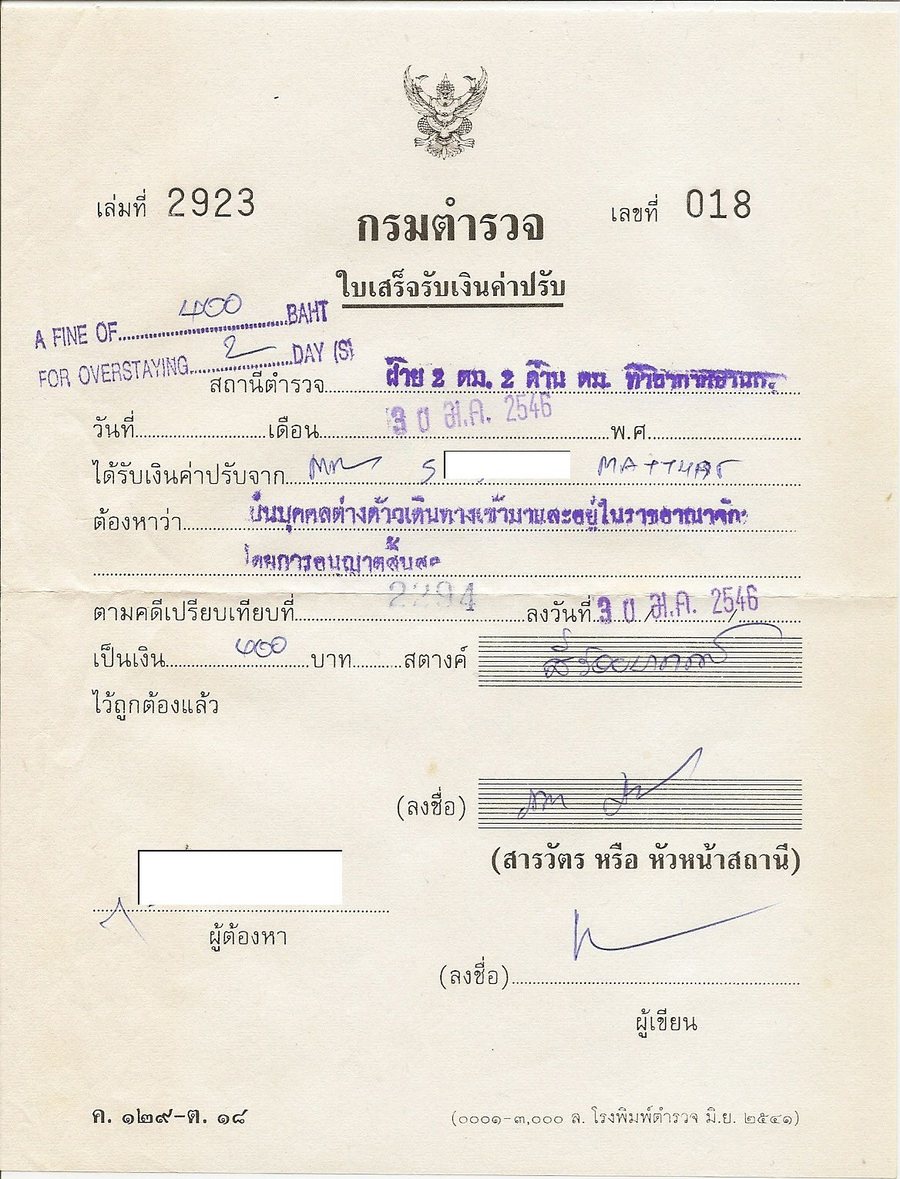
And the rate only moves one way. The receipt below is a genuine Thai police overstay fine slip for two days, issued in 2003 when the fine was 200 baht a day. The same two days today cost 1,000 baht.
The Thailand travel costs that are not counted in baht
The fine is the cheap part. Overstaying is an offence under section 81 of the Immigration Act, and whether you report it yourself or are found out changes the consequence completely.
| Overstay | If you present yourself and pay | If you are caught |
|---|---|---|
| Up to 90 days | Fine only, no ban | 5-year ban |
| More than 90 days | 1-year ban | 5-year ban |
| More than 1 year | 3-year ban | 10-year ban |
| More than 3 years | 5-year ban | 10-year ban |
| More than 5 years | 10-year ban | 10-year ban |
A 30-day overstay declared at the airport is 15,000 baht and no ban. The identical 30 days, discovered at a roadside check or a hotel registration instead, is 15,000 baht and five years of not coming back. The fine is paid in cash at the immigration counter before departure, and if you cannot pay it you may be held until you can — which is the one scenario in which a 220-baht ATM fee is the least of your problems.
Check before you act. Immigration practice varies by office and by officer, extensions are granted at discretion, and the figures above were read on 24 November 2026. The Immigration Bureau call centre is 1178. Nothing here is legal or immigration advice — confirm with immigration or your embassy before you rely on it, and never with an agent who offers to fix an overstay.
Three Thailand travel tips that pay for the extension
Change money properly and the fee pays for itself. The gap between an airport arrivals kiosk and a city counter on a 20,000-baht change is routinely wider than 1,900 baht. Our money exchange finder lists the SuperRich Thailand and Vasu branches by district, and a better Thai baht exchange is the single easiest saving in this article.
Eat where the extra month is cheap. Thirty more days only works if your daily spend is honest: cheap food in Bangkok still runs 50 to 70 baht a plate at a street stall against 300 in a mall, and a local SIM card in Thailand costs a fraction of a month of roaming — see our guide to Thai SIM card prices.
Price the whole stay, not the stamp. Put your real dates into our free Thailand trip cost calculator and see what 30 extra days does to the total before you queue for them.
Bottom line: your Thailand travel costs savings summary
- Extension of stay: 1,900 baht, once, for up to 30 days, on form TM.7. All-in about 2,100 baht, or 70 baht a day.
- Overstaying instead: 500 baht a day, capped at 20,000 at 40 days. A month costs 15,000 — 12,900 baht worse than extending.
- Break-even: 3.8 days. Any overstay of four days or more costs more than the extension.
- Flying out to reset: 4,000–8,000 baht and two days, including a 1,120-baht departure charge. Save that by extending unless you wanted the trip anyway.
- Border run: cheaper in cash, but limited to two visa-free land entries per calendar year and two days of your holiday.
- The uncounted cost: presenting yourself means no ban under 90 days; being caught means five years, whatever you pay.
None of this makes Thailand an expensive country. It is a country where a plate of rice and pork is 50 baht and a city bus fare starts at 8, and where a whole extra month of that costs 1,900 baht at a counter. The travellers who lose money here are not the ones who overspend; they are the ones who never looked at the date in the stamp.
Frequently asked questions
How much does it cost to extend a 30-day visa exemption in Thailand?
The fee is 1,900 baht — about $56, £43 or €51 — for one extension of up to 30 days, applied for on form TM.7 at a Thai immigration office before your stamped date expires. Budget another 100 to 170 baht for photographs and copies, plus transport, and expect to spend a morning on it. Approval is at the officer’s discretion.
How much is the overstay fine in Thailand?
500 baht for every day, up to a maximum of 20,000 baht, which is reached at 40 days. It is payable in cash at the immigration counter before you leave, and a few hours’ overstay on the day of departure is usually waived. Overstaying is also an offence under section 81 of the Immigration Act, punishable by a fine of up to 20,000 baht, up to two years’ imprisonment, or both.
Is a border run cheaper than a Thailand visa extension?
In cash, sometimes: from Bangkok a land border round trip runs roughly 1,000 to 1,600 baht against about 2,100 for an extension. It is rarely cheaper once you price the two days it eats, and visa-free entry by land is generally limited to twice per calendar year, so a border run spends a scarce allowance as well as money. Nationals of Malaysia, Brunei, Indonesia and Singapore are not subject to that land cap.
Can I extend a Thailand visa exemption twice?
No. A visa-exempt entry can be extended once, for up to 30 days. After that you must leave Thailand or change to another visa category, and the switch generally has to be started while at least 15 days of your permitted stay remain. Holders of a 60-day tourist visa get the same single 30-day extension at the same 1,900-baht fee.
Work out what this costs you
Rules and fees change; your budget should keep up. Estimate your Thailand trip budget — flights, rooms, food and transport in baht and your own currency, in about two minutes.
Build my Thailand budget →Source:
Reporting this piece draws on. Rules change — check the primary source before you act on anything here.
- TAT Newsroom (Tourism Authority of Thailand), "Thailand introduces new 30-day and 15-day visa exemption rules from 15 September", dated 1 September 2026 (first published 21 May 2026, updated 16 July 2026): Ministry of Interior announcements published in the Royal Gazette on 31 August 2026 and effective 15 September 2026; passport holders of 60 listed countries and territories receive visa exemption for tourism with a permitted stay of up to 30 days; Seychelles and Mauritius receive 15 days; entry under the exemption through land border checkpoints is generally limited to no more than twice per calendar year, not applying to nationals of Malaysia, Brunei Darussalam, Indonesia and Singapore or others designated by the Minister; Visa on Arrival applies to holders of passports from Azerbaijan, Belarus and Serbia; separate bilateral arrangements providing 90, 30 or 14 days continue where relevant; the page does not mention extension of stay (cited in article dated: 2026-11-24)
- Royal Thai Embassy, Washington DC, "Advice on Thailand Visa Overstay Regulations" (embassy advisory page, imported and last updated 14 September 2023, so predates the current figures): the minimum overstay charge is 500 baht per day, rising to a maximum of 20,000 baht for overstays of 40 days or longer; the page's worked example is seven days at 500 baht for 3,500 baht; a few hours' overstay on the day of departure is usually waived; it is easiest to pay when flying out, where the airport immigration office directs the traveller to a nearby counter to pay the fine; being unable to pay can mean being held until funds are raised; an overstay of more than 90 days is described as a serious offence leading to deportation and a ban whose length depends on the overstay, while paying the fine and leaving leaves no black mark; repeated overstays can lead to a passport annotation as an undesirable alien (cited in article dated: 2026-11-24)
- The Thaiger, "Thailand's new visa rules start today: Full guide for tourists and expats", published 15 September 2026 and last modified 25 September 2026 (a news site, so a secondary source): travellers admitted under the 30-day exemption may apply at a Thai immigration office for an extension of up to another 30 days before their authorised stay expires; the application fee is 1,900 baht; documents are form TM.7, the passport, a recent photograph, copies of the relevant passport and entry pages and proof of address in Thailand, plus anything else the local office requests; approval and length are at the officer's discretion; 15-day and Visa on Arrival entrants should not assume the same routine 30-day extension; Visa on Arrival is limited to Azerbaijan, Belarus and Serbia at 2,000 baht; land-border entries under the 30-day exemption may generally be made no more than twice per calendar year (cited in article dated: 2026-11-24)
- ThaiLawOnline, "Visa Exemption Thailand: The 30-Day Rule", published 5 September 2026 and last updated 30 September 2026 (a law-firm glossary page, so a secondary source): a visa-exempt stay can be extended once by up to 30 days at any immigration office on form TM7 for 1,900 baht, applied for before the stamped date expires, with no second extension available - the traveller must then leave or switch to a non-immigrant visa while at least 15 days remain; overstay is 500 baht per day capped at 20,000 baht, with bans of one year or more for overstays over 90 days; only two visa-exempt entries by land are allowed per calendar year, excepting Malaysia, Brunei, Indonesia and Singapore, with no fixed limit for arrivals by air or sea; a 60-day tourist visa keeps a 60-day stay per entry and is extendable once for 30 days at 1,900 baht (cited in article dated: 2026-11-24)
- Lawmanee, "Overstaying in Thailand: the 500-baht daily fine, re-entry bans and why turning yourself in matters", published 29 September 2026 (a Thai law practice's article, so a secondary source): overstay is 500 baht per day up to a maximum of 20,000 baht, the cap being reached after 40 days; the legal basis is section 81 of the Immigration Act B.E. 2522 (1979), punishable by up to two years' imprisonment, a fine of up to 20,000 baht, or both; re-entry bans under a Ministry of Interior order in force since 20 March 2016 run, for those who present themselves, none up to 90 days, one year over 90 days, three years over one year, five years over three years and ten years over five years, and for those arrested or prosecuted, five years up to one year of overstay and ten years beyond that, the ban running from the day of departure; the fine is usually paid at the immigration counter before departure and a traveller who cannot pay may be held until they can; the Immigration Bureau call centre is 1178 (cited in article dated: 2026-11-24)
- Wikipedia, "Government Complex MRT station" and "Pink Line (Bangkok)" (an encyclopaedia, so a secondary source): the Government Complex station (PK12) is on Chaeng Watthana Road near the Chaeng Watthana Government Complex in Lak Si district, Bangkok, opened on 21 November 2023 in trial operation with the Pink Line officially launched on 18 December 2023 and revenue service from 7 January 2024; the station has four exits and its exit list includes Immigration Division 1; the Muang Thong Thani branch leaves the main line at PK10 and Lake Muang Thong Thani station (MT02) lists the Immigration Bureau among its exits (cited in article dated: 2026-11-24)
Published 24 November 2026. Travel rules, fees and prices change without much warning — always confirm with an official source or your embassy before you book or travel. Nothing here is legal, immigration or financial advice.