
Flying out of Thailand now costs 1,120 baht a head in airport passenger service charge, up from 730 baht on 20 June 2026. The money is already inside your ticket price, there is nothing to pay at the airport, and a family of four is 1,560 baht — about £35 — worse off than it would have been in May. Take off from Krabi, Surat Thani or U-Tapao instead and the same charge is 400 baht.
This is the line of Thailand travel costs almost nobody budgets for, because almost nobody sees it. The passenger service charge, or PSC, is the airport's fee for handling a departing passenger, and at the six airports run by Airports of Thailand it went up by 390 baht per person this year. This budget travel guide sets out exactly what the charge is at every kind of Thai airport, what the increase does to a real trip, the one situation in which you can get the money back, and the two further fees the government has consulted on but not yet introduced. Figures were read on 23 November 2026. Conversions use the Thai baht exchange rates quoted at the 20 November close, when one US dollar bought 33.95 baht, one pound 44.45, one euro 37.26 and one Australian dollar 22.48.
What changed on 20 June 2026
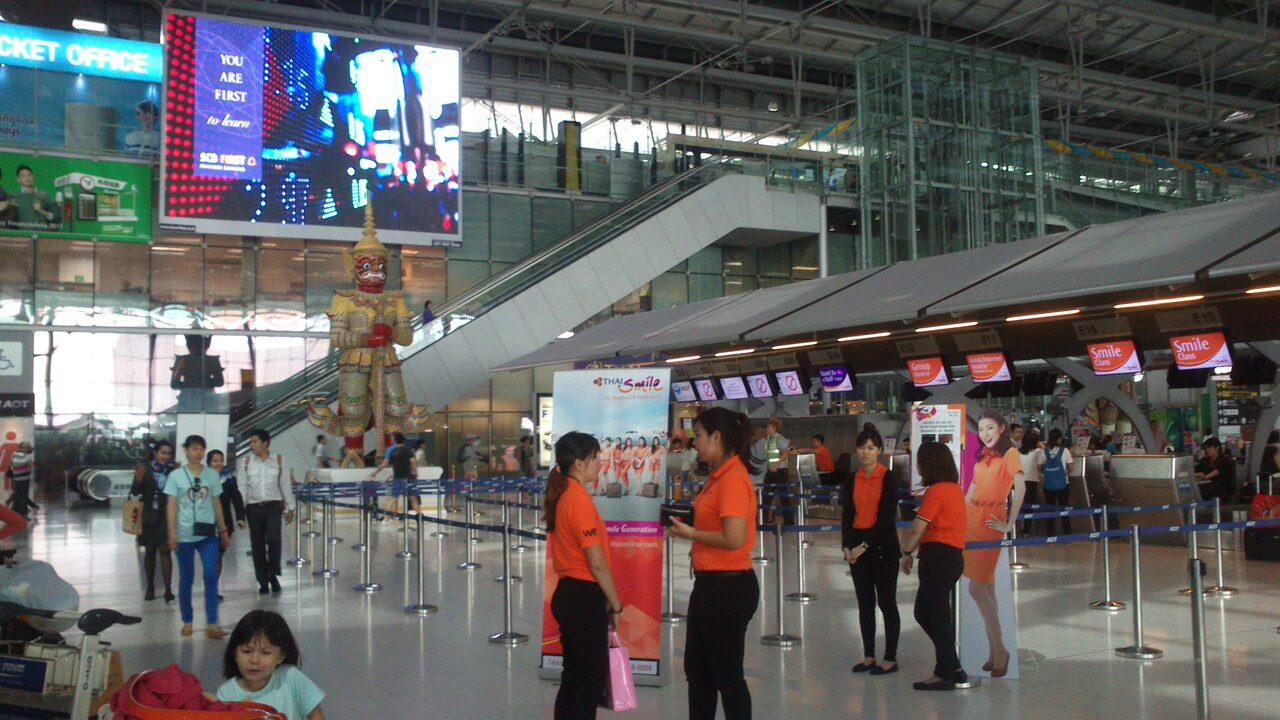
The Civil Aviation Board approved the increase in principle at its meeting on 3 December 2025, chaired by the transport minister, Phiphat Ratchakitprakarn. Airports of Thailand then set the start date at 20 June 2026. The international charge went from 730 to 1,120 baht per departing passenger; the domestic charge stayed at 130 baht. AOT's president, Paweena Jariyathitipong, put the rise down to International Civil Aviation Organization standards and rising operating costs, and AOT expects it to raise roughly 10 billion baht a year from around 35 million passengers, earmarked for terminal work at Suvarnabhumi and Don Mueang.
It is the single largest one-day move in Thailand travel costs this year, and two details about it matter for your wallet. First, the charge is collected inside the air fare, so there is no desk, no queue and no separate payment — and no way to opt out. Second, the new rate attaches to the ticketing date, not the travel date. Tickets issued before 20 June 2026 were not re-billed, so a long-haul return bought in February and flown next month still carries the old 730.
Thailand travel costs by airport: who charges what
Thailand does not have one departure fee. It has a schedule set by airport operator, and the gap between the top and bottom of it is now wider than it has ever been.
| Airport operator | Airports | International (THB) | Domestic (THB) |
|---|---|---|---|
| Airports of Thailand | Suvarnabhumi, Don Mueang, Phuket, Chiang Mai, Hat Yai, Mae Fah Luang–Chiang Rai | 1,120 | 130 |
| Department of Airports | Krabi, Surat Thani, Nakhon Si Thammarat, Ubon Ratchathani, Khon Kaen, Phitsanulok, Trang, Chumphon, Ranong and others | 400 | 50 |
| Samui (privately run) | Samui | 700 | 300 |
| U-Tapao | U-Tapao–Rayong–Pattaya | 400 | 50 |
| Sukhothai | Sukhothai | 500 | 200 |
| Trat | Trat | — | 200 |
Only the AOT row is confirmed at a 2026 rate. The others are the figures published in the government's own explainer of the 2017 Ministry of Transport announcement on departure passenger service charges, and that page has not caught up — it still lists AOT at 700 and 100 baht, two rate changes behind. Treat the non-AOT numbers as the published schedule rather than today's till receipt, and expect the Department of Airports ones to move: the same December 2025 meeting cleared the DOA to go to a maximum of 425 baht international and 75 baht domestic, conditional on new common-use check-in systems being installed and on four months' notice to passengers.
What the increase costs a real trip
Per person, 1,120 baht is about $33, £25, €30 or A$50. That is not a trip-breaking number on a long-haul fare, but it is a real one against the average cost per day in Thailand, which for a mid-range traveller runs roughly 1,500 to 2,500 baht in everyday Thailand travel costs. One departure now eats half a day of your budget before you have bought a coffee.
| Party | Paid now (THB) | Paid before 20 June (THB) | Extra (THB) | Extra in GBP / USD |
|---|---|---|---|---|
| Solo traveller | 1,120 | 730 | 390 | £8.77 / $11.49 |
| Couple | 2,240 | 1,460 | 780 | £17.55 / $22.98 |
| Family of four | 4,480 | 2,920 | 1,560 | £35.10 / $45.95 |
Put the extra 390 baht next to what it buys on the ground and it stops being abstract. It is eight rides on the Airport Rail Link at 45 baht, the standard way to handle Suvarnabhumi airport transit into town. It is seven or eight plates of cheap food in Bangkok at street prices. It is more than a month of data on most tourist SIMs. For a family, the 1,560-baht increase is a night in a decent guesthouse that nobody got to sleep in.
Where the departure charge is cheaper
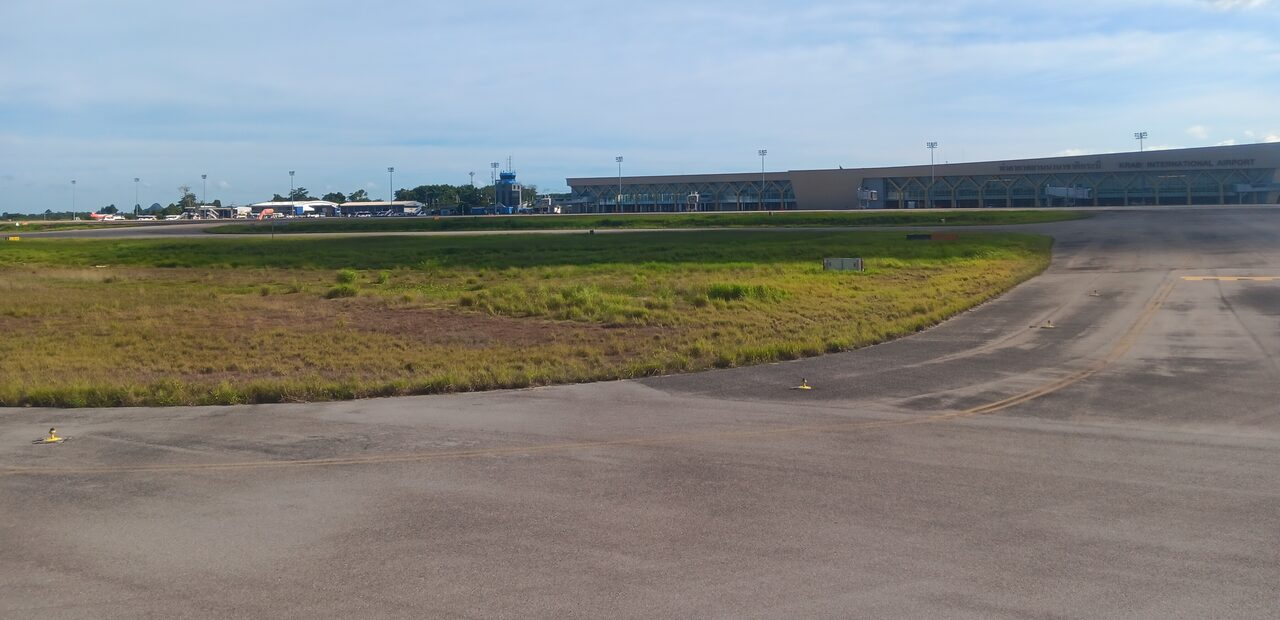
The 720-baht gap between an AOT airport and a Department of Airports one is the only part of this you can actually act on, and it is narrower in practice than it looks on paper. International routes from DOA airports are thin: Krabi and U-Tapao have regional low-cost services to Malaysia, Singapore and China, and that is largely it. Nobody should ride a 12-hour bus to save 720 baht.
Where it does pay is when you are already down south or out east at the end of a trip and have a regional hop to make. Two people flying Krabi–Kuala Lumpur instead of backtracking to Bangkok save 1,440 baht in charges alone, before the cost of the positioning flight they did not take. The same logic applies in reverse to domestic legs: an internal flight carries 130 baht at an AOT airport and 50 at a DOA one, so a domestic positioning hop never attracts the international charge.
Transfer and transit passengers are a separate case. The increase as announced applies to passengers departing Thailand, and AOT has said it is preparing a proposal to seek approval to charge transit and transfer passengers too. Until that happens, connecting through Bangkok is not the same as departing from it — another reason to check whether your itinerary is ticketed as one journey or two.
The refund almost nobody claims
Here is the piece of this worth knowing even if you never fly out of Krabi. The passenger service charge is levied on passengers who actually depart. If you do not fly, the charge can be reclaimed from the airline, and the Thai government's own guidance says so: travellers may request a refund of the airport tax from the carrier under certain circumstances, including events outside the airline's control that stop them travelling.
This is the rare line of Thailand travel costs you can get back after the event, and the procedure is unglamorous. Email the airline's customer service or call centre with the booking name, the flight details or booking reference, the ticket number and a contact number. If you booked through an agent or online travel site, go to them first. Expect a processing fee on some carriers, and note that whether the fare itself comes back depends entirely on your ticket type — the taxes and charges are a separate question from the fare, which is exactly why people throw away a non-refundable ticket without asking. On a missed long-haul departure for two, that is 2,240 baht of PSC sitting in an airline's account unclaimed.
Proposed, not in force. Two further charges have been consulted on and neither is law as at 23 November 2026. The Ministry of Tourism and Sports has a draft 450-baht fee on foreign tourists arriving by air, consulted on between 24 August and 28 September 2026, with part of the money funding insurance for payers; no start date has been announced. The Revenue Department has consulted, from 30 September to 29 October 2026, on a draft Departure Tax Act that would charge 1,000 baht on departures by air, of all nationalities, with a 5,000-baht statutory ceiling. If both arrive at the proposed rates, a foreign visitor would face 2,570 baht in fees. Cabinet approval, publication in the Royal Gazette and actual enforcement are three different things, and none of them has happened. Our tourist entry fee status page tracks the arrival side.
Three Thailand travel tips that cover the 390 baht
Change money properly and the increase disappears. The spread between an airport exchange kiosk and a city booth on a 20,000-baht change is routinely wider than 390 baht. Our money exchange finder lists the SuperRich Thailand and Vasu counters by district, and the Thai baht exchange rate you get at Phaya Thai or Pratunam is the single easiest saving in this whole article.
Buy the local SIM card in Thailand, not the roaming bundle. A tourist SIM from a 7-Eleven or an operator counter costs a fraction of a week of roaming, and the difference is several times the fee increase. Our guide to Thai SIM card prices has the current packages.
Price the whole trip, not the fare. Airport charges, baggage, transfers and the first taxi are where cheap travel in Thailand quietly stops being cheap. Put your own dates into our free Thailand trip cost calculator and watch what two departures do to a two-week budget.
Bottom line: the Thailand travel costs savings summary
- International departure, AOT airport: 1,120 baht a person, up 390 since 20 June 2026. Unavoidable, and already in your fare.
- International departure, DOA airport or U-Tapao: 400 baht. Save 720 baht a person when a southern or eastern regional route genuinely suits your route home.
- Domestic flights: 130 baht at AOT airports, 50 at DOA ones — the increase does not touch them.
- Tickets issued before 20 June 2026: still 730 baht, with no add-collect. Worth 390 baht a person on long-booked trips.
- If you do not fly: ask the airline for the passenger service charge back. Worth 1,120 baht a person, separately from whatever the fare does.
- Proposed only: a 450-baht arrival fee and a 1,000-baht departure tax. Budget for them from 2027, not for this trip.
None of this makes Thailand expensive. A country where a plate of rice and pork costs 50 baht and a Bangkok bus fare starts at 8 can absorb a 390-baht airport charge without anyone cancelling a holiday. But it is a charge that arrived quietly, inside a number most people never break down, and the travellers who lose most to it are the ones who miss a flight and never think to ask for it back. Know it is there, know what it is called, and know that it is only due if you actually leave.
Frequently asked questions
How much is the Thailand airport departure fee in 2026?
It is 1,120 baht per person for an international departure from an Airports of Thailand airport — Suvarnabhumi, Don Mueang, Phuket, Chiang Mai, Hat Yai or Mae Fah Luang–Chiang Rai — following an increase from 730 baht on 20 June 2026. Domestic departures from those airports are 130 baht. At Department of Airports airports such as Krabi and Surat Thani the published international charge is 400 baht.
Do I have to pay the Thailand departure fee at the airport?
No. The passenger service charge is one of the Thailand travel costs collected by the airline when the ticket is issued, and it is included in the fare you pay. There is no counter to visit and no cash to carry, which is why the June 2026 increase passed most travellers by.
Can I get the Thailand airport tax refunded if I do not fly?
Often, yes, and it is separate from whether your fare is refundable. The charge is due on passengers who actually depart, so travellers who do not fly can ask the airline to refund the airport tax, in writing, with the booking name, flight or booking reference, ticket number and a contact number. Ticket agents and online travel sites should be approached first, and some airlines deduct a processing fee.
Is Thailand introducing a new tourist tax in 2027?
Two charges have been consulted on and neither is in force as at 23 November 2026: a 450-baht fee on foreign tourists arriving by air, proposed by the Ministry of Tourism and Sports, and a 1,000-baht departure tax on air departures of all nationalities, drafted by the Revenue Department with a 5,000-baht statutory ceiling. Neither has an announced start date, and consultation is not the same as enforcement.
Work out what this costs you
Rules and fees change; your budget should keep up. Estimate your Thailand trip budget — flights, rooms, food and transport in baht and your own currency, in about two minutes.
Build my Thailand budget →Source:
Reporting this piece draws on. Rules change — check the primary source before you act on anything here.
- TAT Newsroom (Tourism Authority of Thailand), "Airports of Thailand to raise international passenger service charge from 20 June 2026", published 18 May 2026: the international passenger service charge (PSC) rises from 730 baht to 1,120 baht per person effective 20 June 2026 at all six AOT airports - Suvarnabhumi, Don Mueang, Chiang Mai, Mae Fah Luang-Chiang Rai, Phuket and Hat Yai - for Thai and foreign passengers alike; the domestic PSC remains unchanged at 130 baht per person; the charge is included in the air fare at ticket purchase and travellers are not required to make any separate payment at the airport; tickets issued from 20 June 2026 onward reflect the new rate while tickets purchased before the effective date are not affected; the increase is stated to fund airport operations, infrastructure development and technology upgrades (cited in article dated: 2026-11-23)
- The Nation (Thailand), "AOT hikes departure service charge to 1,120 baht - Exit tax still under review", published 9 May 2026: AOT raises the international departure PSC from 730 to 1,120 baht per person from 20 June 2026, adding 390 baht to existing costs at Suvarnabhumi, Don Mueang, Chiang Mai, Mae Fah Luang-Chiang Rai, Phuket and Hat Yai; AOT president Paweena Jariyathitipong cites ICAO standards and rising operating costs; AOT describes the PSC as part of the fees already incorporated into air fares; a separate 1,000-baht exit tax for travellers leaving Thailand remains under study by the Ministry of Finance and is not finalised (cited in article dated: 2026-11-23)
- The Nation (Thailand), "AOT gets approval to increase passenger service charge from 730 to 1,120 baht starting 2026", published 4 December 2025: the Civil Aviation Authority of Thailand approved the increase at a meeting chaired by Transport Minister Phiphat Ratchakitprakarn; AOT estimates about 10 billion baht in additional annual revenue from roughly 35 million passengers a year across its six airports, earmarked for Suvarnabhumi expansion including a new South Passenger Terminal; the same decision allows the Department of Airports to raise its charges to a maximum of 425 baht per international flight (from 400) and 75 baht per domestic flight (from 50), conditional on common-use passenger processing systems being installed and on at least four months' notice to passengers; DOA airports named include Krabi, Surat Thani, Ubon Ratchathani, Khon Kaen, Nakhon Si Thammarat, Phitsanulok and Trang (cited in article dated: 2026-11-23)
- Thailand.go.th (Royal Thai Government portal), "Airport tax in Thailand: If the passenger does not fly, can the tax be refunded?", undated explainer citing the 2017 Ministry of Transport announcement on departure passenger service charges at licensed airports: international PSC per person of 700 baht at Airports of Thailand airports, 400 baht at Department of Airports airports (Chumphon, Ranong, Surat Thani, Nakhon Si Thammarat, Krabi, Trang, Pattani, Narathiwat), 700 baht at Samui, 500 baht at Sukhothai and 400 baht at U-Tapao; domestic PSC of 100 baht at AOT airports, 50 at DOA airports, 300 at Samui, 200 at Sukhothai, 200 at Trat and 50 at U-Tapao (the AOT figures on this page predate the 2026 increase); travellers who do not fly may request a refund of the airport tax from the airline under certain circumstances, by email or letter to customer service giving the booking name, flight details or booking number, ticket number and a contact number, approaching a reseller first where one was used, subject to each airline's conditions and possible processing fee (cited in article dated: 2026-11-23)
- LoyaltyLobby, "Airports Of Thailand Increase Passenger Departure Tax To THB 1,120 From June 20, 2026", published 23 February 2026 (an aviation blog, so a secondary source): the new rate applies on the ticketing date, with no add-collect on tickets already issued; the domestic charge stays at 130 baht; the increase follows Civil Aviation Board resolution 3/2568 of 3 December 2025; AOT is reported to be preparing a proposal to seek approval to charge PSC on transit and transfer passengers, who are not covered by this increase (cited in article dated: 2026-11-23)
- The Nation (Thailand), "Foreign visitors could face 2,570 baht in Thailand travel fees", published 8 October 2026: adds the in-force 1,120-baht AOT international PSC to two proposals - a 450-baht fee on foreign tourists arriving by air from the Ministry of Tourism and Sports, consulted on online from 24 August to 28 September 2026 with 80.5 per cent of participants supporting the draft and 78.3 per cent the 450-baht rate, paid into the Tourism Promotion Fund and partly funding insurance for payers, with collection from land and sea arrivals postponed by a year; and a 1,000-baht departure tax on air departures of all nationalities drafted by the Revenue Department, consulted on from 30 September to 29 October 2026, with a statutory maximum of 5,000 baht per departure. Neither proposal had an announced start date, cabinet approval or gazette publication at the time of the report (cited in article dated: 2026-11-23)
Published 23 November 2026. Travel rules, fees and prices change without much warning — always confirm with an official source or your embassy before you book or travel. Nothing here is legal, immigration or financial advice.