
An ordinary cream-and-red bus in Bangkok charges 8 baht to the end of its route. A Grab across the same four kilometres costs around 120. That is a fifteen-fold difference for a journey that often takes the same time, because the bus and the car are sitting in exactly the same traffic.
Buses are the cheapest moving thing in the city and the line almost every visitor leaves out of their Thailand travel costs. This budget travel guide puts hard 2026 figures on them: what each type of bus charges, how the 40-baht HOP daily cap works, what a full day of moving around costs by bus against the BTS and against Grab, and the Suvarnabhumi airport transit fare that saves you 400 baht on arrival. At roughly 33.8 baht to the US dollar in early November 2026, every number below is in baht first, because baht is what the conductor wants.
Thailand travel costs on a Bangkok bus: the 2026 fare table
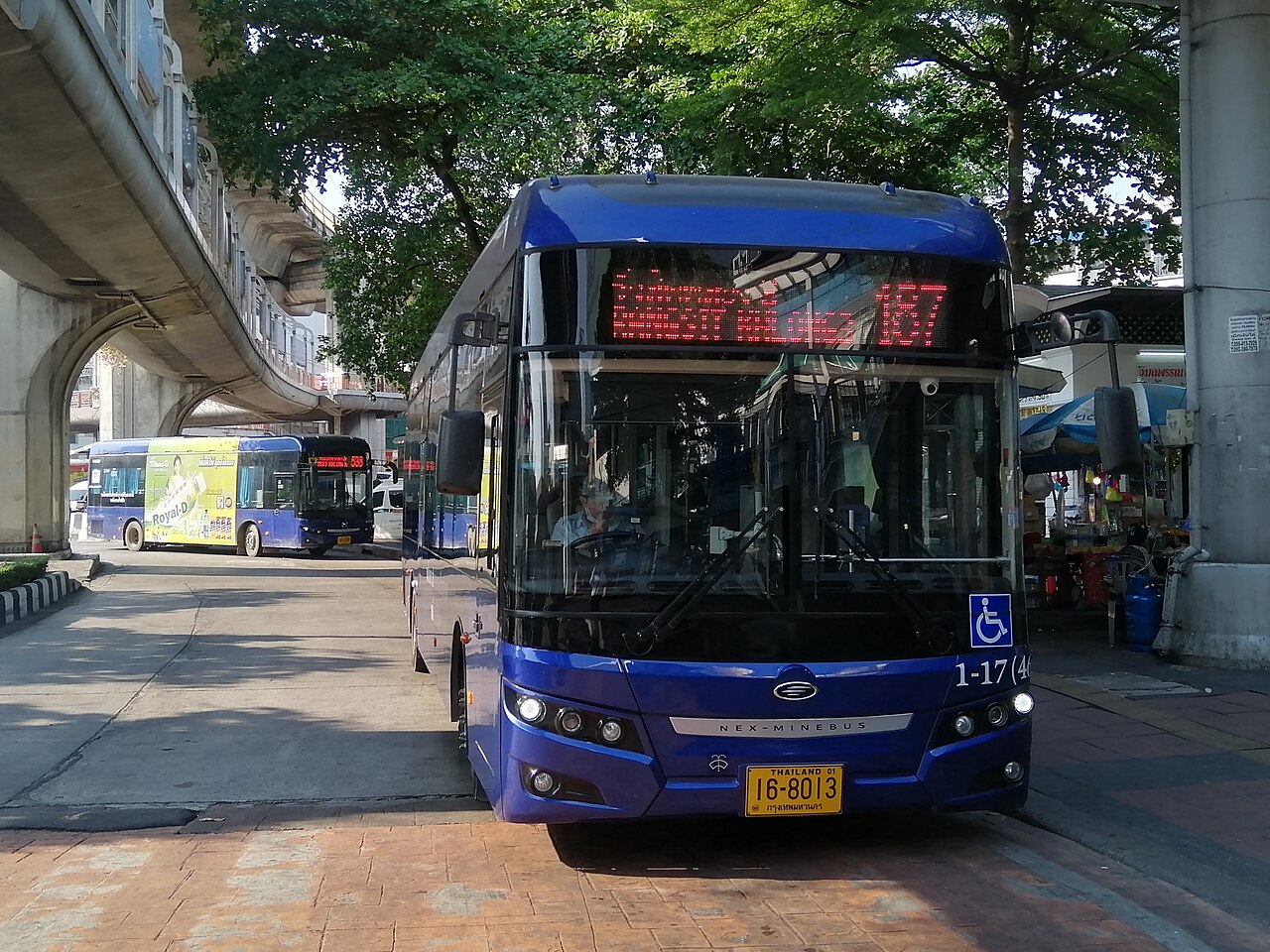
Bangkok runs two overlapping bus systems. The Bangkok Mass Transit Authority (BMTA) operates the old fleet and licenses private operators; Thai Smile Bus runs the newer all-electric buses on its concession routes. They charge differently, and which one pulls up at your stop is luck.
| What pulls up | Fare (THB) | In USD | How it is charged |
|---|---|---|---|
| Ordinary non air-conditioned (cream and red) | 8–10 | $0.24–0.30 | Flat, any distance on the route |
| All-night ordinary bus, 23:00–05:00 | 9.50 | $0.28 | Flat, whole route |
| BMTA air-conditioned | 12–25 | $0.36–0.74 | By distance, plus 2 baht on the expressway |
| Thai Smile “hot bus” (non air-conditioned electric) | 10 | $0.30 | Flat, on the routes that run them |
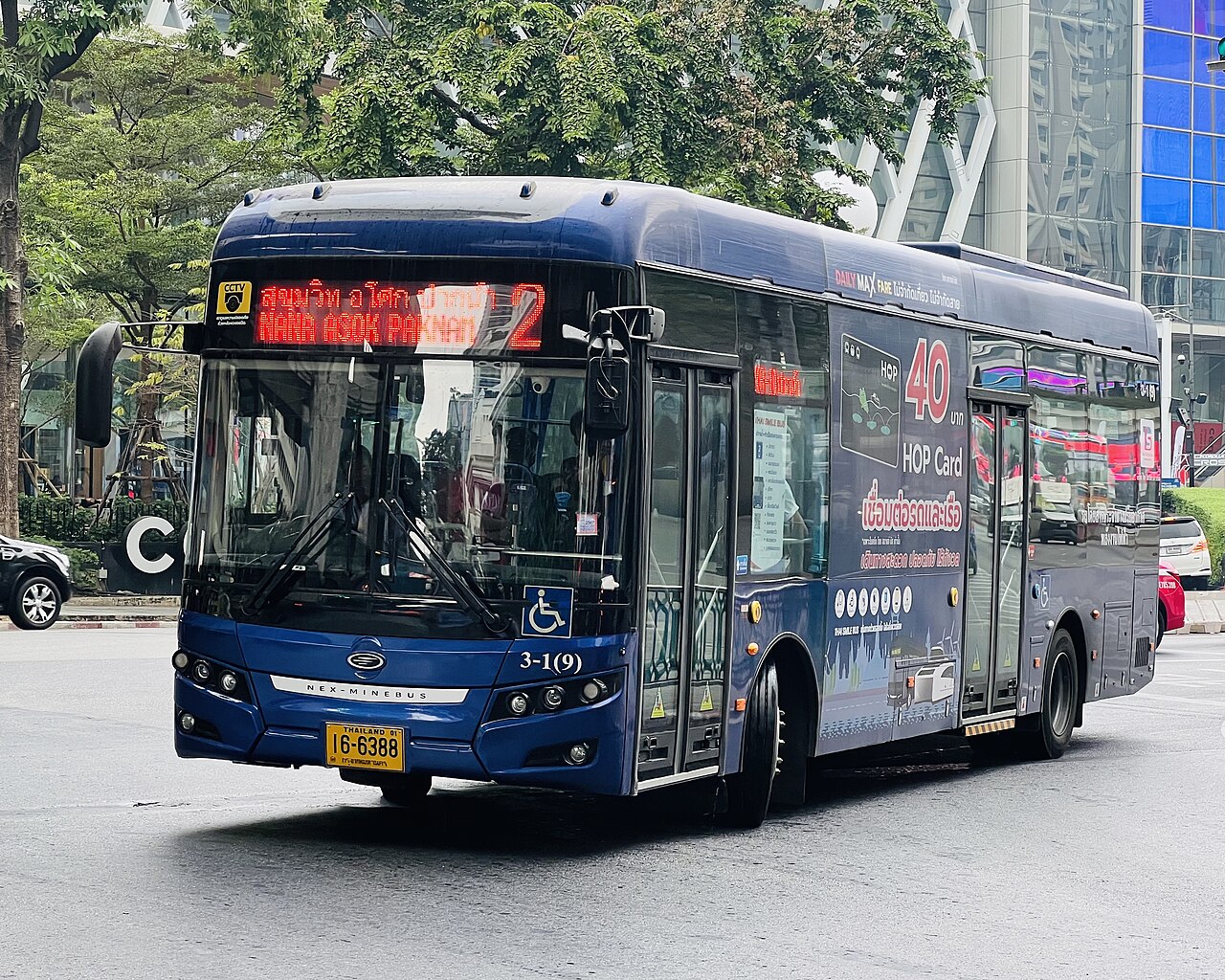
| Thai Smile electric, up to 4 km | 15 | $0.44 | By distance |
| Thai Smile electric, 4–16 km | 20 | $0.59 | By distance |
| Thai Smile electric, over 16 km | 25 | $0.74 | Plus 2 baht on the expressway |
| HOP card daily cap, buses only | 40 | $1.18 | Unlimited rides that day |
| HOP card daily cap, buses and electric boats | 50 | $1.48 | Unlimited rides that day |
| Child fare, Thai Smile electric | 10–25 | $0.30–0.74 | By distance, capped at 25 |
Honest caveat on these numbers: the ordinary and BMTA air-conditioned fares come from the Thai government’s own public-transport page, last updated in mid-2023, and the Thai Smile figures from the operator’s published bands. Bangkok’s bus network has been under route reform since 2024 and fares move without much notice. Treat the shape of the ladder as reliable and check the exact figure on the fare chart inside the bus.
The 40-baht HOP card, the best Thailand travel tip nobody gives tourists
The HOP card launched in December 2022 with the Ministry of Transport and it is the single cheapest piece of plastic in Bangkok. It buys unlimited travel on the Thai Smile Bus network for a flat 40 baht a day, or 50 baht a day if you also use the company’s electric boats on the Chao Phraya and Khlong Saen Saep. Children are capped at 25. You tap in when you board and tap out when you leave, so the system can work out whether you have hit the cap.
When the cap actually pays
Do the arithmetic before you buy. Two long rides at 25 baht come to 50, so the cap has already saved you 10. Four mid-length rides at 20 baht come to 80 against 40 — half price. A sightseeing day of six hops is 120 baht paid in cash and still 40 on the card. The card only loses if you take one short ride and then stop, which is not how a day in Bangkok goes. Cards are sold online, at Tops supermarkets, at Market Village, on board the buses themselves and at the larger ferry piers.
One thing the card does not cover: the much-publicised 20-baht flat fare on Bangkok’s electric trains. That scheme needs registration with a Thai national ID, so it is not available to visitors — the detail is in our Bangkok BTS and MRT fares guide.
Bus vs BTS vs Grab: a day of Thailand travel costs compared
Take a normal tourist day: hotel to a temple, temple to lunch, lunch to a market, market back to the hotel. Four journeys, mostly 4 to 10 kilometres, all inside the city. Here is the same day bought four ways.
| How you move | Typical single fare | Four journeys | Seven days | Week in USD |
|---|---|---|---|---|
| Grab or metered taxi | 90–150 THB | 480 THB | 3,360 THB | $99.41 |
| BTS and MRT | 17–65 THB | 180 THB | 1,260 THB | $37.28 |
| Electric bus, cash | 15–25 THB | 80 THB | 560 THB | $16.57 |
| HOP card daily cap | capped | 40 THB | 280 THB | $8.28 |
| Ordinary non air-con bus | 8 THB | 32 THB | 224 THB | $6.63 |
Against a week of Grab, the HOP card saves 3,080 baht, about $91. Against a week of Skytrain, it still saves 980 baht, roughly $29. Set that beside an average cost per day Thailand budget of 1,000 to 1,200 baht and the bus habit buys back two and a half days of travel in a single week.
The honest counterweight is time. A bus crawling down Sukhumvit in the 17:00 jam will lose twenty minutes to the Skytrain running above it. The sensible split is rail at rush hour and buses, boats and feet the rest of the day — the same logic as our Bangkok taxi, Grab and tuk-tuk fare guide, where the meter is fine at midnight and ruinous at six.
Suvarnabhumi airport transit and the 60-baht bus
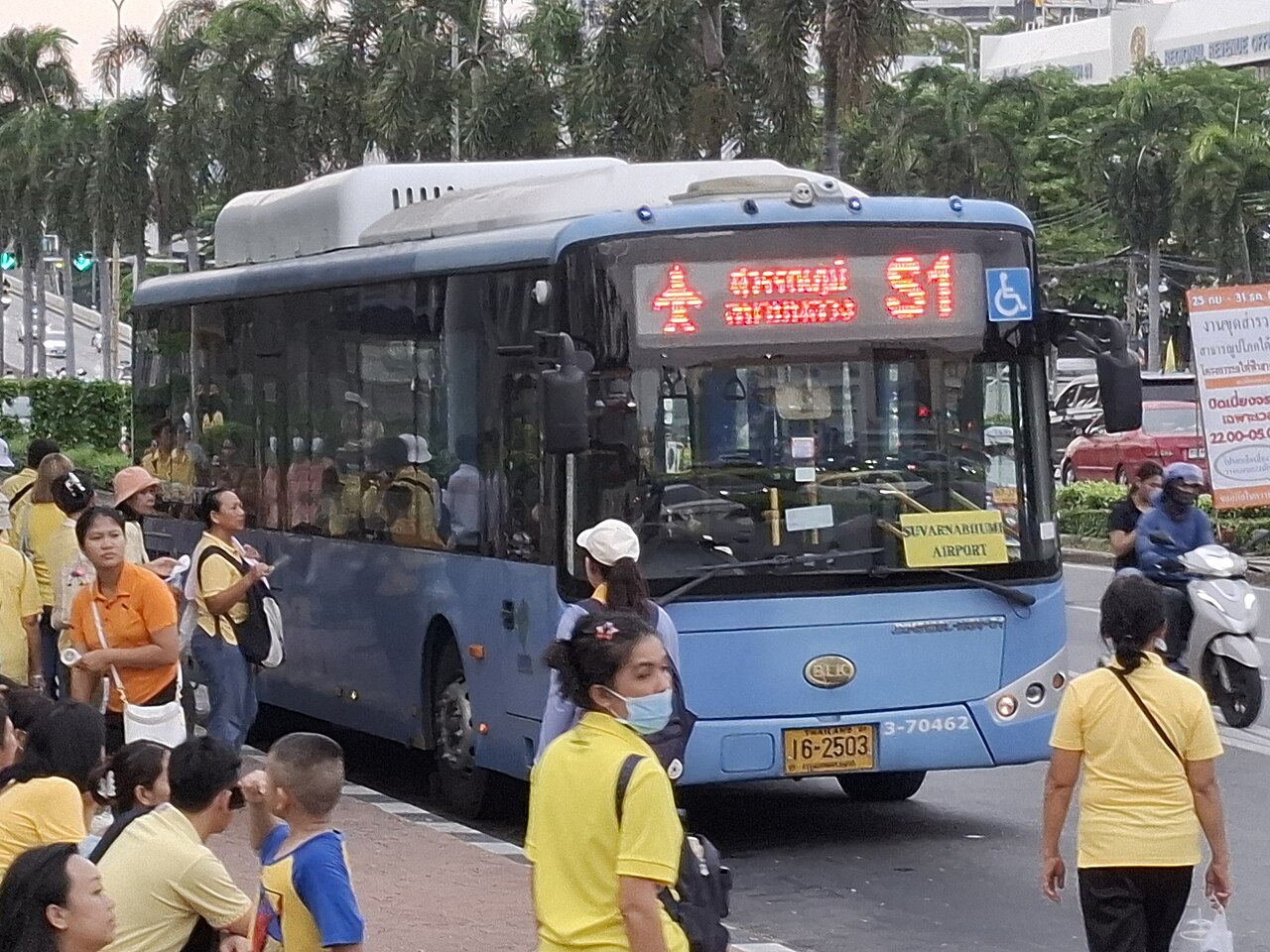
The bus saves you the most money on the day you arrive, when you are tired and most likely to accept a kerbside quote. The S1 public bus leaves the Suvarnabhumi Public Transport Centre for Khao San and Sanam Luang at 60 baht a head. A metered taxi for the same run is 300 to 400 baht on the meter plus a 50-baht airport surcharge and 70 to 110 baht of expressway tolls paid in cash — call it 420 to 560 all in.
At Don Mueang the equivalents are the A1 bus to Mo Chit and the A2 to Victory Monument, both 30 baht flat, and the SRT Dark Red Line at 33. The full comparison, including the Airport Rail Link at 45 baht, is in our Suvarnabhumi to Bangkok transfer guide. Two airport runs taken by bus rather than taxi save roughly 800 baht, which in Thailand budget travel terms is a night in a decent guesthouse.
How to pay, and why you need small notes
On the older buses a conductor works the aisle with a metal ticket tube, takes your cash and clips a paper ticket. Tell them where you are going, hand over coins or a 20, and keep the ticket: inspectors do check. Nobody can break a 1,000-baht note, so split one at a 7-Eleven before you reach the stop — the same trick that makes cheap food in Bangkok easy to buy, as in our 7-Eleven prices guide.
The electric fleet is further ahead. Thai Smile buses have taken QR payments through PromptPay across all routes and e-wallet payments including TrueMoney since 1 March 2025, alongside the HOP card, and cash is still accepted everywhere. Those digital options generally assume a Thai bank account or wallet, so for most visitors the practical choice is cash for a one-off ride and a HOP card for a serious day out.
Route numbers are the last trap. The network has been renumbered during the reform — the famous route 8, for example, now runs as 2-38 — so an old blog post or a printed map may send you to the right stop for the wrong number. Check the number on the LED board at the front of the bus, not the one in the guidebook.
The money side: your Thai baht exchange and the 220-baht ATM fee
A week of bus travel costs 280 baht on the cap. One careless cash withdrawal can cost most of that again: every Thai ATM charges a foreign card a flat 220 to 250 baht per withdrawal, before your own bank adds its margin, and the fee is the same whether you take 2,000 baht or 20,000. Our Thailand ATM fees guide does the withdrawal maths.
Carrying cash and changing it usually wins. A licensed booth — the SuperRich Thailand counters among them — takes a fraction of a per cent rather than a flat fee, and our Thailand money exchange finder maps the branches near the stations you will already be passing. Whatever you do, decline the machine or card terminal that offers to bill you in your home currency; that is dynamic currency conversion and it adds 3 to 8 per cent.
Bottom line: the savings summary
Bangkok buses are slow, crowded, occasionally baffling and the single lowest line in your Thailand travel costs. Buy a HOP card on day one, cap your travel at 40 baht, and take the S1 or the A1 from the airport instead of a taxi.
| Swap | You pay | Instead of | You save |
|---|---|---|---|
| HOP card vs Grab, one week | 280 THB | 3,360 THB | 3,080 THB ($91) |
| HOP card vs BTS and MRT, one week | 280 THB | 1,260 THB | 980 THB ($29) |
| S1 bus vs taxi, airport to Khao San | 60 THB | 420–560 THB | 360–500 THB |
| Ordinary bus vs electric bus, four rides | 32 THB | 80 THB | 48 THB |
Across a fortnight, the bus habit is worth about 6,160 baht against a taxi habit — more than a return flight to Chiang Mai, a week of street food, or five nights in a decent room. Drop your own figures into our free Thailand trip cost calculator and see what moving around by bus does to the bottom of your trip budget.
Work out what this costs you
Rules and fees change; your budget should keep up. Estimate your Thailand trip budget — flights, rooms, food and transport in baht and your own currency, in about two minutes.
Build my Thailand budget →Source:
Reporting this piece draws on. Rules change — check the primary source before you act on anything here.
- Royal Thai Government, Public transportation in Bangkok, published 16 January 2023 and last updated 30 June 2023: regular cream-red buses 8-10 baht; air-conditioned buses (Blue-Cream, Euro II Yellow-Orange, PBC White and NGV Blue) 12-25 baht by distance with an additional 2 baht if the bus uses the expressway; all-night regular buses 23:00-05:00 at 9.50 baht throughout the route; normal service hours 05:00-23:00 (cited in article dated: 2026-11-05)
- Wikipedia - Thai Smile Bus: non air-conditioned electric 'hot buses' at a flat 10 baht; air-conditioned electric fares of 15 baht up to 4 km, 20 baht for 4-16 km and 25 baht over 16 km, plus a 2-baht expressway surcharge; HOP card daily caps of 40 baht for buses and 50 baht including electric ferries, child cap 25 baht; HOP introduced with the Ministry of Transport in December 2022, requires tapping in and out, and is sold online, at Market Village and Tops Supermarket, on board buses and at certain major ferry terminals; 123 bus routes as of 2025 and a 100 per cent electric fleet (cited in article dated: 2026-11-05)
- The Nation - Transport Ministry launches joint electric bus-boat card for Bangkok commuters, 22 December 2022: the HOP Card was launched by Transport Ministry permanent secretary Chayatham Promsorn, giving unlimited daily travel at 40 baht a day on Thai Smile Bus electric buses across more than 120 Bangkok routes, or 50 baht a day including electric boats on the same platform; 1,250 electric buses were in service at launch (cited in article dated: 2026-11-05)
- The Nation - Smile! Bangkok electric buses free for children until yearend, 3 May 2024: child fares on Thai Smile Bus start at 10 baht and are capped at 25 baht; the HOP card gives unlimited daily rides at a flat 40 baht, or 50 baht including the electric boats; the operator ran a fleet of around 3,000 all-electric buses (cited in article dated: 2026-11-05)
- The Thaiger - Bangkok buses now accept QR code and e-wallet payments, 3 March 2025: Thai Smile Bus accepts PromptPay QR payments across all routes and digital e-wallet payments including TrueMoney Wallet from 1 March 2025, following trials on route 4-13 (75); the HOP card daily maximum fare remains 40 baht; cash payments are still accepted (cited in article dated: 2026-11-05)
- Wikipedia - Transport in Bangkok: the Bangkok Mass Transit Authority operates a monopoly on bus services with concessions to private operators including Thai Smile Bus; 3,506 BMTA buses run alongside private joint buses, minibuses, songthaews and vans totalling 16,321 vehicles on 470 routes; BMTA bus route reform changed 107 routes from 25 July 2024 (cited in article dated: 2026-11-05)
- Wikipedia - Bus No. 8 (Bangkok): the former route 8 was transferred to Thai Smile Bus and renumbered 2-38, running Happy Land to Memorial Bridge, with the Ministry of Transport opening the electric service on 19 August 2022 (cited in article dated: 2026-11-05)
Published 5 November 2026. Travel rules, fees and prices change without much warning — always confirm with an official source or your embassy before you book or travel. Nothing here is legal, immigration or financial advice.