
Thailand travel costs on Bangkok's roads come down to a decision you make in about three seconds: the metered taxi at the kerb, the app on your phone, or the tuk-tuk whose driver has already named a price. The same six-kilometre crosstown trip is roughly 110 baht on the meter, 120–160 through an app and 250–300 in a tuk-tuk — for identical seats in identical traffic.
This budget travel guide prices every road option in Bangkok for October 2026 against the official tariff and current app fares, then works out what the wrong habit costs across a ten-day trip. Figures are at roughly 32 baht to the US dollar.
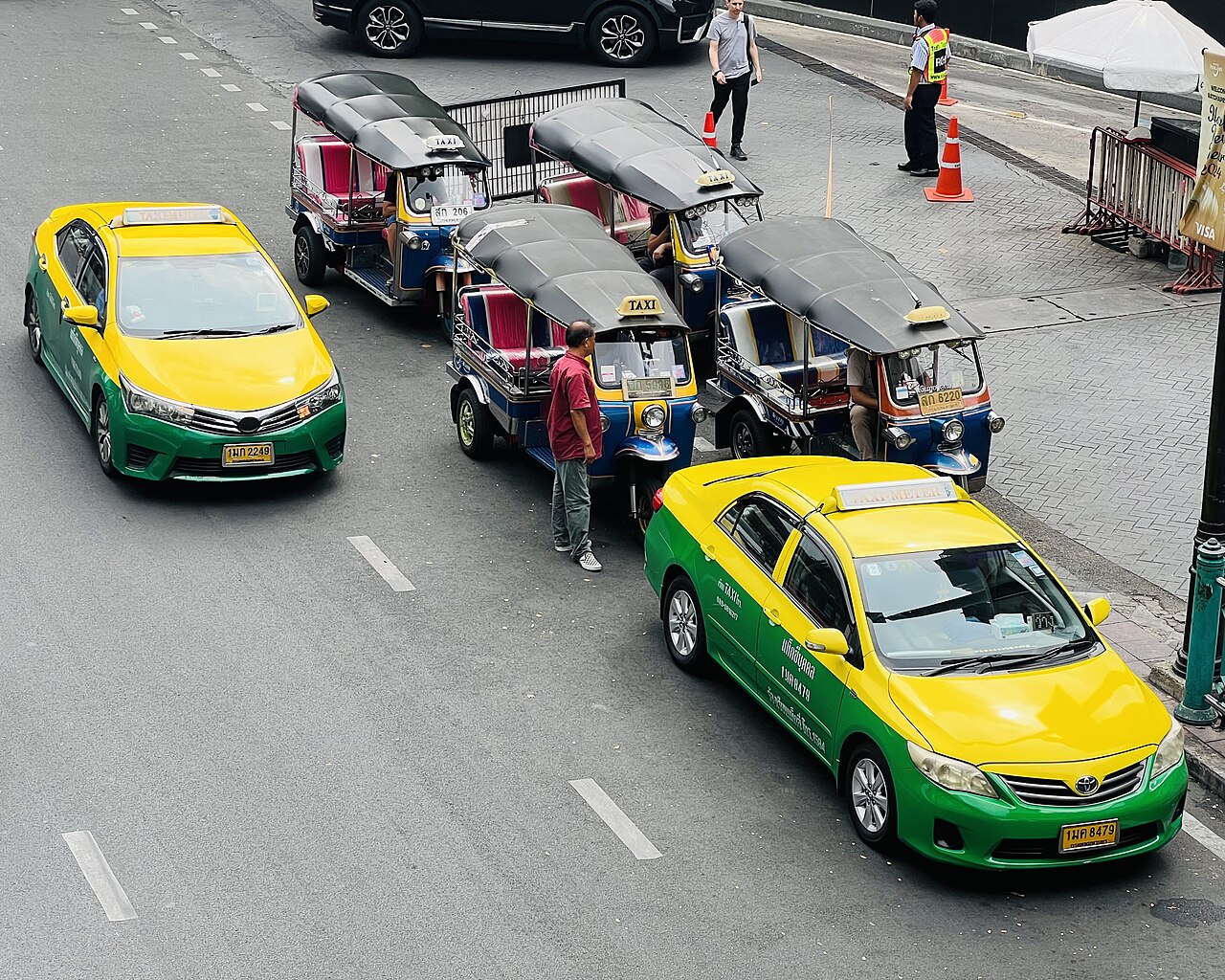
Thailand travel costs on the meter: the official Bangkok taxi tariff
Bangkok taxi fares are fixed by the Department of Land Transport and have not changed since the January 2023 increase. Every licensed cab — green and yellow, pink, orange or blue — runs the identical table, so the colour of the car tells you nothing about the price.
| Charge | Rate (THB) | Note |
|---|---|---|
| Flag fall, first 1 km | 35 | 40 in a large SUV or MPV cab |
| 1–10 km | 6.50 / km | Covers most city trips |
| 10–20 km | 7.00 / km | |
| 20–40 km | 8.00 / km | Airport distance |
| 40–60 km | 8.50 / km | |
| 60–80 km | 9.00 / km | |
| Over 80 km | 10.50 / km | |
| Stopped or under 6 km/h | 3.00 / minute | The traffic charge |
| Airport rank pickup | +50 once | Suvarnabhumi and Don Mueang |
| Phone, radio or app booking | +20 once | Includes GrabTaxi metered cabs |
| Expressway tolls | 25–75 per section | Passenger pays, in cash |
The three-baht-a-minute clock is what you actually pay for
Distance in Bangkok is cheap. Time is not. A seven-kilometre run across town is 74 baht of pure distance — 35 for the first kilometre, then six more at 6.50. Add fifteen minutes of crawling at 3 baht a minute and the meter reads about 119 baht. The same trip at 6pm in the rain can stand still for forty minutes and finish near 180.
That is the honest version of Thailand travel costs by taxi: the meter is mostly a traffic report with a price on it. Leaving at 10am instead of 6pm on that one trip saves 60 baht and twenty-five minutes, which is the single most useful of all Thailand travel tips for getting around Bangkok.
Grab vs Bolt vs the meter: Bangkok app fares compared
Apps quote a fixed price before you get in, which removes the meter argument entirely. Bolt consistently undercuts Grab by 10–25 per cent on the same route; both surge 1.3–2.5x in rush hour and 2–3x in heavy rain, when a street-hailed meter suddenly becomes the cheap option — if you can find one.
| Route | Bolt (THB) | Grab (THB) | Street meter, typical |
|---|---|---|---|
| Siam → Silom | 65–95 | 80–120 | 60–90 |
| Sukhumvit Soi 11 → Yaowarat | 100–130 | 120–160 | 95–140 |
| Khao San → Asiatique | 110–150 | 130–180 | 100–150 |
| Thong Lo → Chatuchak | 120–170 | 150–200 | 120–180 |
| Suvarnabhumi → Sukhumvit | 320–380 | 380–450 | 300–420 inc. surcharge and tolls |
| Don Mueang → Khao San | 260–320 | 300–380 | 270–350 inc. surcharge and tolls |
On a ten-kilometre trip with no surge, Bolt lands at 120–150 baht against Grab's 140–180. Run four such trips a day and the app you picked at the airport is worth about 120 baht a day, or 1,200 across ten days — roughly $38, for installing a second free app.
When the app wins and when it loses
Off-peak and in light traffic, a street meter is usually 10–25 per cent cheaper than a Grab fixed fare, because you are not paying a platform margin. Book through Grab and you also add the 20-baht call surcharge on a metered cab. In rush hour, rain or anywhere a driver can see you are a tourist, the app wins decisively: a fixed 150 beats an argument that starts at 300.
The non-negotiable rule is simple. If the driver will not drop the flag, get out and wave down the next cab — there are more than 80,000 of them in Bangkok and the next one is thirty seconds away. A quoted price from a metered taxi is always worse than the meter, or it would not be quoted.
Tuk-tuk prices: the most expensive seat in Bangkok
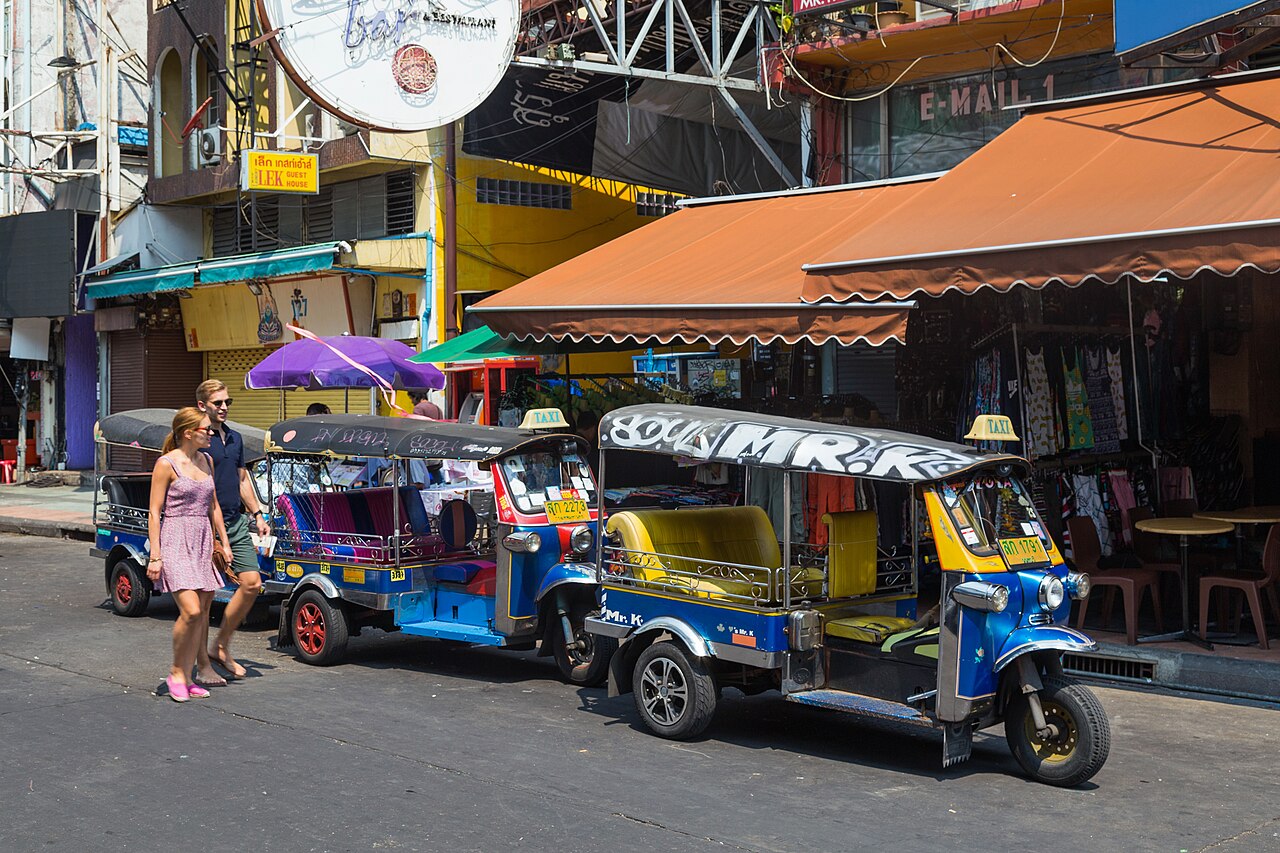
Tuk-tuks have no meter, no tariff and no obligation to be reasonable. Expect 50–100 baht for one or two kilometres, 100–200 for two to five, and 150–300 or more for anything longer — two to three times the metered fare for an open-sided ride in the exhaust. An opening quote of 150 on a short hop should be countered at 80–100, and checking the Grab or Bolt estimate first gives you a number to argue with.
One tuk-tuk a day instead of a taxi costs a couple about 300 baht extra daily, or 3,000 over ten days — about $94, which is four nights of a decent guesthouse. Ride one once because it is fun, then stop.
The 20-baht tuk-tuk that costs you an afternoon
A driver offering a tour for 20–50 baht is not being generous: he earns a fuel voucher for delivering you to a gem shop or a tailor, and the stops are the trip. The matching line is "the Grand Palace is closed today, Buddha festival" — the Grand Palace is open daily from 08:30 to 15:30 and never closes for a festival a stranger tells you about on the pavement. Walk to the official ticket gate and check yourself.
Motorbike taxis, trains, and the 160-baht day
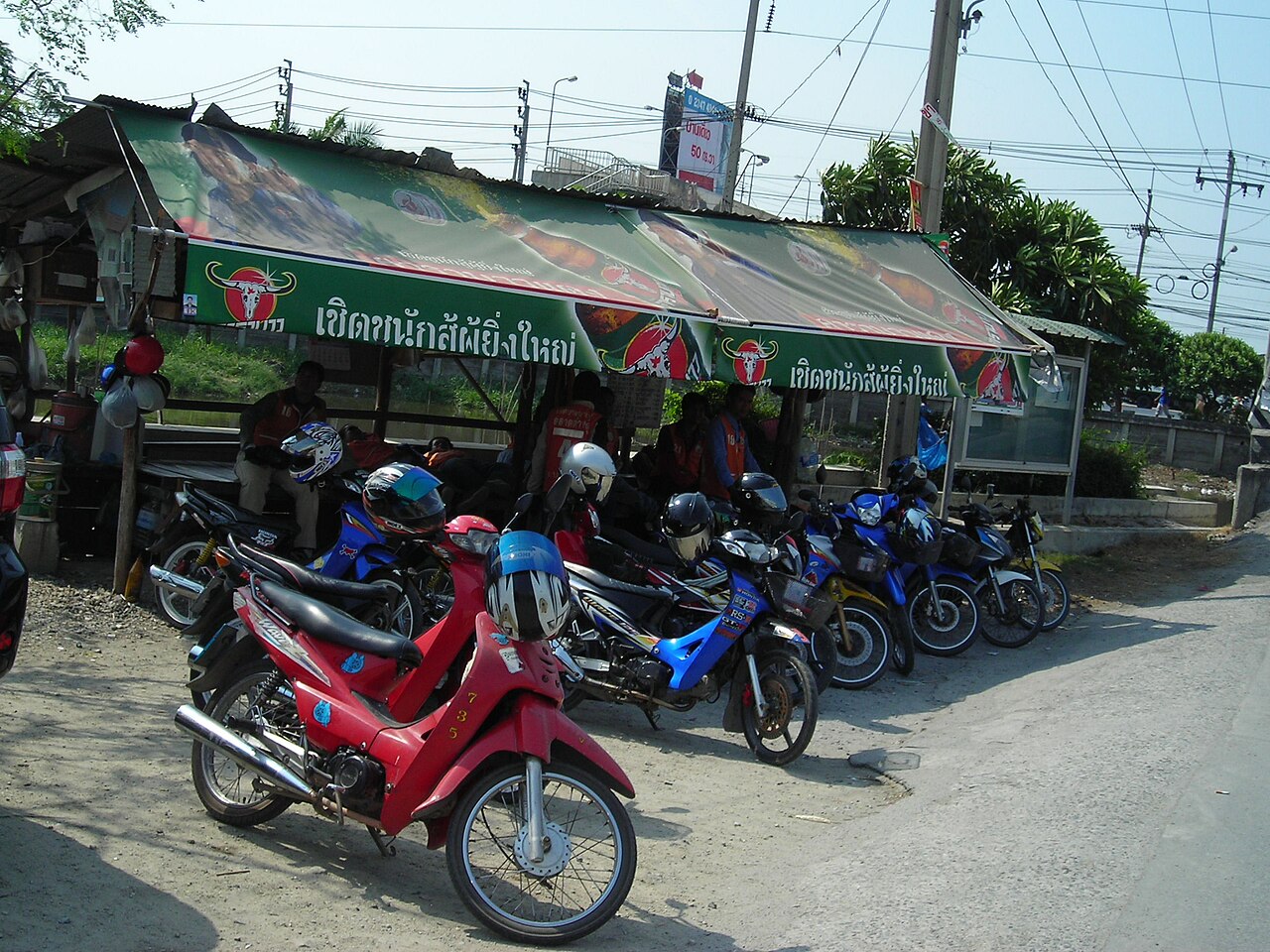
For the last kilometre from a station to your hotel, the orange-vest motorbike taxi is 20–40 baht and faster than anything on four wheels. Agree the price before you sit down; most ranks have a posted board.
Above the traffic, BTS fares run 17–65 baht by distance and the MRT 14–45, with Chao Phraya commuter boats at 20 baht and ordinary buses at 8. Do not budget for the much-publicised 20-baht flat train fare: that scheme requires a Thai ID, the network-wide version was dropped before launch in June 2026, and what survives is a 40-baht daily cap on the Red and Purple lines until 30 November 2026. Our Bangkok BTS and MRT fares guide has the full table.
| Four crosstown trips a day | Daily (THB) | Ten days, two people |
|---|---|---|
| Tuk-tuks at tourist quotes | 1,000 | 20,000 |
| Grab | 600 | 12,000 |
| Bolt | 480 | 9,600 |
| Street meter, off-peak | 440 | 8,800 |
| Two rail trips plus two Bolt rides | 320 | 6,400 |
| BTS, MRT and boats only | 160 | 3,200 |
Against an average cost per day Thailand-wide of 1,500–2,500 baht for mid-range travellers, moving from tuk-tuks to a rail-and-app mix frees up 680 baht a day — most of a room, or a week of cheap food in Bangkok at 40–60 baht a dish.
Where Thailand travel costs leak on Bangkok roads
- Accepting a flat quote from a metered cab. 300 baht for a 110-baht trip, repeated four times a day, is 760 baht gone daily.
- The airport limousine counter. The desks inside arrivals sell 1,000–1,500 baht transfers; the official rank downstairs is the meter plus 50 baht and tolls. See our Suvarnabhumi airport transit guide for the cheaper rail option.
- No data, no apps. Both apps need a connection to quote a price, which is the real argument for sorting a local SIM card Thailand-side on arrival — our Thailand eSIM guide starts at 499 baht.
- Paying tolls twice. Tolls are 25–75 baht per section and the passenger pays them in cash at the booth. Hand over the exact note; "keep the change" on three booths is 60 baht.
- Cash you bought badly. Every one of these fares is paid in baht, and a poor Thai baht exchange taxes all of them. A SuperRich Thailand-style booth beats an airport kiosk by around 900 baht on $500.
- Stacking ATM fees. Thai banks charge a flat 220 baht per foreign-card withdrawal; our Thailand ATM fees guide lists the cards that refund it.
Bottom line: the Thailand travel costs savings summary
- Install Bolt as well as Grab. 10–25 per cent cheaper on the same route, worth about 1,200 baht over ten days.
- Insist on the meter, or walk to the next cab. A quoted taxi fare is never cheaper than the meter.
- Take the train for anything over three kilometres in rush hour. 17–65 baht, and it does not sit in traffic.
- Use motorbike taxis for the last kilometre. 20–40 baht and the quickest thing on the road.
- Ride one tuk-tuk, for the photo. Then price everything else properly.
Do those five and two people cover ten days of Bangkok transport for around 6,400 baht instead of 20,000 — a difference of roughly $425, which is the flight upgrade, the islands, or four nights nobody had budgeted for. Put your own numbers in with our Thailand trip budget estimator before you book anything.
Bangkok taxis, Grab and tuk-tuks: quick answers
How much is a taxi in Bangkok in 2026?
The meter starts at 35 baht for the first kilometre, then charges 6.50 baht per kilometre up to 10 km, 7 baht to 20 km and 8 baht to 40 km, plus 3 baht per minute whenever the cab is stopped or below 6 km/h. A typical seven-kilometre crosstown trip costs about 110–120 baht with normal traffic. Airport rank pickups add 50 baht, phone or app bookings add 20 baht, and expressway tolls of 25–75 baht per section are paid by the passenger.
Is Grab or Bolt cheaper in Bangkok?
Bolt is cheaper on most routes, typically by 10–25 per cent. A ten-kilometre trip with no surge runs 120–150 baht on Bolt against 140–180 on Grab. Both apps surge 1.3–2.5 times in rush hour and up to three times in heavy rain. Grab has wider driver coverage outside central Bangkok and more frequent discount codes, so having both installed and comparing quotes is the cheapest approach.
Are tuk-tuks cheaper than taxis in Bangkok?
No. Tuk-tuks have no meter and typically cost two to three times a metered taxi for the same distance: 50–100 baht for one to two kilometres, 100–200 for two to five and 150–300 or more beyond that. Tuk-tuks parked outside tourist attractions quote the highest prices, and any offer of a 20–50 baht tour includes compulsory stops at gem shops or tailors.
What should I do if a Bangkok taxi driver refuses the meter?
Get out and hail another one. Refusing the meter is illegal, and with more than 80,000 taxis in Bangkok the next cab is usually seconds away. If you would rather not negotiate at all, book through Grab or Bolt, which quote a fixed price in the app before the trip starts.
Work out what this costs you
Rules and fees change; your budget should keep up. Estimate your Thailand trip budget — flights, rooms, food and transport in baht and your own currency, in about two minutes.
Build my Thailand budget →Sources
Reporting this piece draws on. Rules change — check the primary source before you act on anything here.
- Nation Thailand - Bangkok taxi fare tariff: flag fall, distance bands and surcharges
- Thaiest - Bangkok taxi meter price per kilometre and booking surcharges 2026
- Hootling - How much does a taxi cost in Bangkok: 2026 fare guide
- Thai Guys - Grab vs Bolt in Bangkok 2026: route-by-route price test
- Thailand Knowledge - Grab vs Bolt Thailand 2026: price comparison and coverage
- Bangkok Travel Guide - How to get a tuk-tuk in Bangkok 2026: prices and negotiation
- Marat Nomad - Bangkok taxi fare guide: motorbike taxis, tolls and airport surcharge
Published 2 October 2026. Travel rules, fees and prices change without much warning — always confirm with an official source or your embassy before you book or travel. Nothing here is legal, immigration or financial advice.