
Cheap travel Thailand starts with a number painted on the roof of a pickup truck. In Chiang Mai the shared red songthaew — the rot daeng — carries a printed fare cap of 30 baht per person, about 90 US cents, and that one line of paint is the difference between a 1,700-baht week of getting around and a 3,400-baht one. Most visitors never read it. They lean in at the driver's window, ask “how much?”, and get told 100.
This budget travel guide prices every realistic way of moving around Chiang Mai in October 2026: the 30-baht shared red truck, the 20–30 baht RTC city bus, Grab, the tuk-tuks parked outside the Night Bazaar, and the 40-baht shared ride up the mountain to Doi Suthep that plenty of people pay 400 for. At roughly 33.5 baht to the dollar, the gap between the cheap version of a week here and the lazy version is about $50 — against an average cost per day Thailand-wide of 1,500 to 2,500 baht, that is a third of a day's budget decided at the kerb each morning.
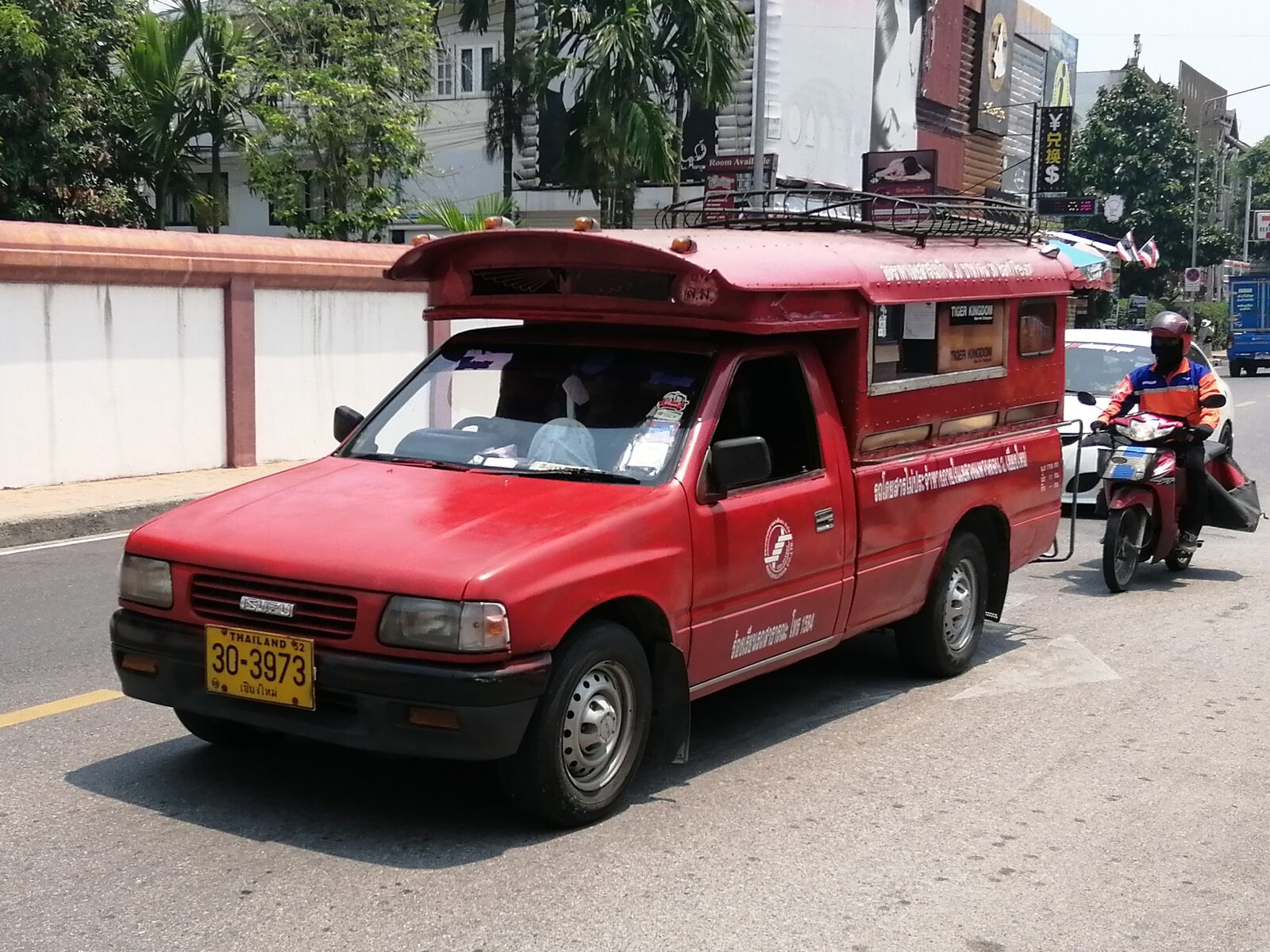
Thailand travel costs: every Chiang Mai fare priced
Read the units before you compare the rows. The first four are per person; a Grab car, a tuk-tuk or a chartered truck is one price for the whole vehicle, which is why groups and solo travellers should read this table differently.
| How you move | Cost (baht) | Unit | Notes |
|---|---|---|---|
| Shared red songthaew, in town | 30 | per person | Capped fare, printed on the roof |
| Shared songthaew, outer districts or airport | 40–60 | per person | Agree it before you climb in |
| RTC city bus (R1–R6) | 20–30 | per person | Fixed routes, daytime, air-conditioned |
| GrabBike motorbike | 50–120 | per rider | Cheapest solo option after dark |
| Grab or Bolt car | 60–200 | per car | Old City to Nimman is 60–90 |
| Tuk-tuk, short hop | 80–150 | per vehicle | No meter; fix the price first |
| Tuk-tuk after 22:00 near the Night Bazaar | 200–400 | per vehicle | Walk 100 metres and flag a red truck |
| Chartered songthaew | 150–300 | per hour | Whole truck, up to about ten people |
| Airport metered taxi | 150–200 | per car | Counter fare is fixed at 160 |
| Scooter rental | 150–300 | per day | Plus 100–150 to fill the tank |
The 30-baht cap is printed on the truck
You do not have to take anyone's word for the fare, and this is the single most useful thing to know about cheap travel Thailand in the north: the cap is written on the vehicle. Along the roof of every city red truck runs a line of Thai with an English translation beside it — 30 Baht/Person. That is the maximum the co-operative sets for a shared hop inside the city, and the small numbered disc on the cab shows the zone the truck is licensed for.
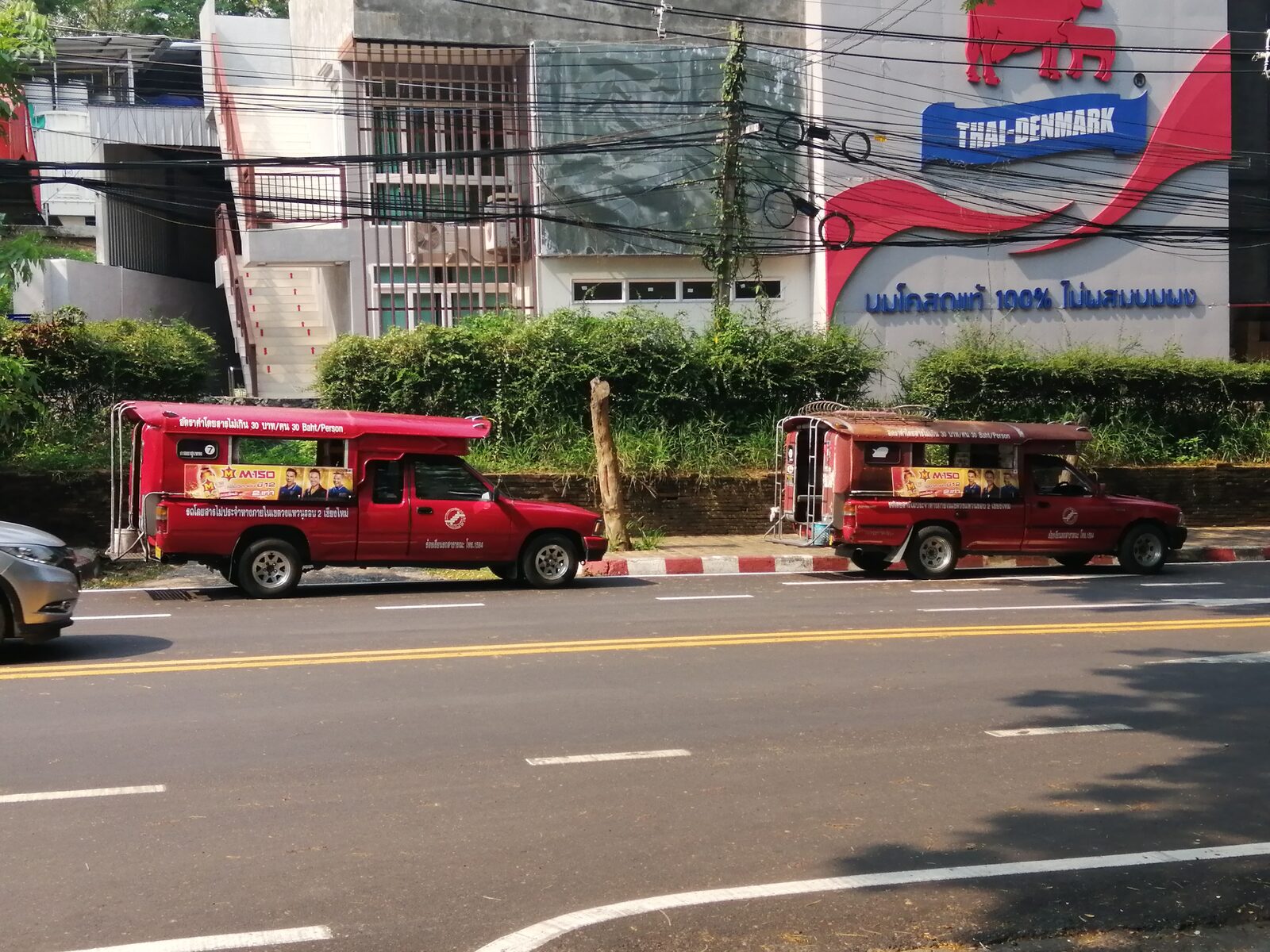
Colour matters too. Red trucks work inside Chiang Mai city; white, blue and yellow songthaews are the out-of-town services running to Hang Dong, Mae Rim, San Kamphaeng and beyond, and they price by distance instead. If a red truck turns your destination down with a head shake, it is outside his zone, not a negotiation.
How to ride without paying a charter price
The mechanics are simple and the mistake is always the same. For a short trip inside the moat, do not ask the fare. Say the destination, or show it on a map, and if the driver nods, climb in the back. Pay 30 baht per person at the driver's window when you get out. Asking “how much?” first invites a quote, and the quote will not be 30 — outside Tha Phae Gate on a Sunday Walking Street evening, 100 to 200 baht for a 30-baht ride is routine. Wave it off; another truck comes past within a minute or two.
Three further Thailand travel tips for the back of a red truck. Carry 20s and 50s, because nobody wants to break a 1,000 at 10pm. Expect detours — the driver drops passengers in the order that suits him, so a 10-minute trip can take 20. And agree a price in advance for anything past the ring road, where 40 to 60 baht a head is normal and perfectly fair.
When chartering at 150–300 baht an hour actually wins
Charter (mao) means you buy the whole truck. Rates run 150 to 300 baht an hour depending on the hour of the day and how hard you smile, and a full day covering Doi Suthep, Wat Pha Lat and the Bhubing Palace gardens is 800 to 1,200 baht for the vehicle. Split four or five ways that is 200 to 250 baht each for a whole day with a driver waiting at every stop — comfortably less than a seat on an organised minibus tour, and you choose the stops. For one or two people it is poor value; for a group it is the best deal in the city.
Doi Suthep for 40 baht, not 400
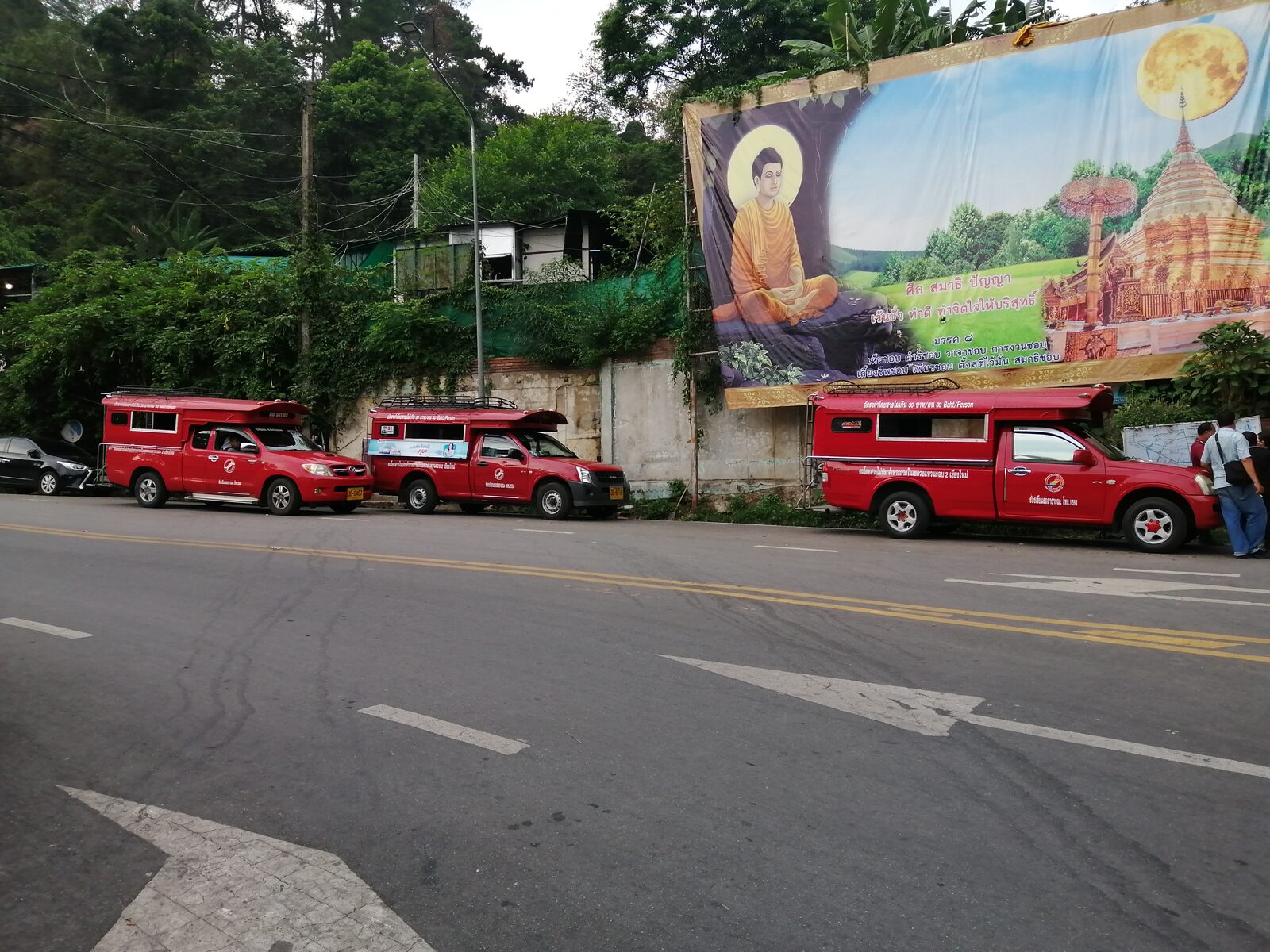
The mountain road is where Thailand travel costs quietly triple. Shared songthaews run up it from two stands, and the fares are fixed and well known:
| From | Doi Suthep | Bhubing (Phuping) Palace | Hmong village |
|---|---|---|---|
| Chiang Mai Zoo entrance | 40 | 70 | 90 |
| Chang Phuak Gate (opposite the 7-Eleven) | 60 | 90 | 120 |
| Grab or Bolt car | 250–400 per car | — | — |
| Charter, whole truck | 500–600 per truck | — | — |
All shared fares are per person, one way. The catch is the wait: trucks leave when they are full, which in practice means about ten passengers, so arriving at 08:30 with the first wave beats turning up at 11:00 alone. The zoo stand is cheaper but needs a 30-baht red truck to reach it; from Chang Phuak Gate you pay 20 baht more and go direct. Temple entry for foreign visitors is 30 baht, and the gates are open 05:00 to 21:00.
For two people doing the temple as a round trip from the zoo stand, that is 160 baht of transport plus 60 baht of entry — 220 baht, about $6.60. The same two in Grab both ways pay 560 to 860. Nobody gets a better view for the extra 500.
Worked example: a couple, one week in Chiang Mai
Four short journeys a day, two people, seven days. Identical trips; only the vehicle changes.
| How you get about | One day, two people | One week |
|---|---|---|
| Shared red songthaew at 30 | 240 | 1,680 |
| RTC city bus at 25 | 200 | 1,400 |
| Grab car at about 90 a trip | 360 | 2,520 |
| Tuk-tuk at 120 a trip | 480 | 3,360 |
| Late-night tuk-tuk quotes at 250 | 1,000 | 7,000 |
The red truck saves 1,680 baht a week against tuk-tuks and 840 against Grab — $50 and $25 respectively, or four nights of guesthouse in low season. Accept the Night Bazaar quotes instead and the week costs 5,320 baht more than it needed to. That is the whole lesson of cheap travel Thailand in one line: the cheap option is not hidden, it is just the one that does not come to you.
Thailand travel tips: where the rest of the money leaks
Two habits undo the savings. The first is changing money badly — a hotel desk or an airport booth typically costs 0.8 to 1.2 baht per dollar more than a city counter, so a $500 Thai baht exchange done lazily burns 400 to 600 baht, or a fortnight of red trucks. The second is buying data at an arrivals counter: a local SIM card Thailand-side from a 7-Eleven or a provider shop in town runs roughly half the airport price for the same 30-day package.
💱 Changing cash in Chiang Mai? Our money exchange finder lists the counters nearest you and shows whether the rate on the board is actually worth walking to.
Bottom line: your cheap travel Thailand savings summary
- 30 baht is the cap, not an opening offer. It is printed in English on the roof of every city red truck.
- Do not ask the price for a short in-town hop. State the destination, board, pay 30 at the window on arrival.
- Agree the fare beyond the ring road. 40 to 60 baht a head to outer districts or the airport is fair.
- Red is city, white and blue are out of town. A head shake means wrong zone, not a haggle.
- Doi Suthep is 40 baht from the zoo stand, 60 from Chang Phuak Gate. Plus 30 baht temple entry, and the truck leaves when it fills.
- Charter at 150–300 an hour only pays with four or more. A full mountain day is 800 to 1,200 for the truck.
- Refuse 200–400 baht tuk-tuk quotes after 22:00. Red trucks run late, and GrabBike is 50 to 120.
- Budget 120–250 baht a day each for transport. That covers four or five shared rides and the odd Grab in the rain.
Chiang Mai is one of the cheapest cities in Thailand to move around, and the saving needs no app, no card and no bargaining — only the confidence to get in without asking. If you are arriving fresh, our guide to Chiang Mai airport to the Old City from 30 baht covers the first ride, and five Thai cities compared by daily cost shows how the north stacks up against Bangkok and the islands. Put your own figures into our Thailand trip budget calculator and see what a fortnight of tuk-tuks would have cost you.
Cheap travel Thailand: quick answers
How much is a songthaew in Chiang Mai?
Thirty baht per person for a shared trip inside the city, and that figure is printed in English along the roof of every red truck. Journeys to outer districts, Maya, the airport or similar distances run 40 to 60 baht per person and should be agreed before you board. Chartering the whole truck costs 150 to 300 baht an hour, or 800 to 1,200 baht for a full day. There is no meter, no ticket and no fixed route: you pay the driver in cash at his window when you get out.
Is a red truck cheaper than Grab in Chiang Mai?
For one or two people, yes. A shared songthaew is 30 baht each, while a Grab or Bolt car for the same hop across town is 60 to 200 baht for the vehicle. For three or four people travelling together the Grab car can work out level or slightly cheaper, and it has the advantage of a fixed price shown before you book. GrabBike, at 50 to 120 baht for a single rider, is the cheapest option late at night when fewer red trucks are circulating.
How do I get to Doi Suthep from Chiang Mai cheaply?
Take a shared songthaew from the stand at the Chiang Mai Zoo entrance for 40 baht per person one way, or from opposite the 7-Eleven at Chang Phuak Gate for 60 baht with no transfer. Bhubing Palace is 70 to 90 baht and the Hmong village 90 to 120. The trucks leave only when roughly ten passengers are aboard, so mornings are quicker. Temple entry for foreign visitors is 30 baht, and the return rank in the temple car park works the same way.
What should I budget per day for transport in Chiang Mai?
About 120 to 250 baht per person per day, which covers four or five shared red truck rides plus the occasional Grab when it rains. Renting a scooter instead costs 150 to 300 baht a day plus 100 to 150 baht of fuel, so it only wins if you are riding a lot or heading out of the city. Relying on tuk-tuks pushes the same day to 400 to 500 baht per person, and accepting late-night Night Bazaar quotes can double that again.
Work out what this costs you
Rules and fees change; your budget should keep up. Estimate your Thailand trip budget — flights, rooms, food and transport in baht and your own currency, in about two minutes.
Build my Thailand budget →Source:
Reporting this piece draws on. Rules change — check the primary source before you act on anything here.
- Byklo - How to get around Chiang Mai 2026: 30-baht shared songthaew fare, 150-300 baht hourly charter, RTC city bus 20-30 baht, Grab and GrabBike ranges, tuk-tuk and scooter prices (cited in article dated: 2026-10-16)
- Cat is Out of the Office - Beginner's guide to riding a Chiang Mai songthaew: 30-baht flat Old City fare, how to board and pay, and the Doi Suthep stand fares from Chiang Mai Zoo and Chang Phuak Gate (cited in article dated: 2026-10-16)
- Chiangmai-trip.com - Getting around Chiang Mai 2026: shared songthaew 30-40 baht, Grab in-town 60-150 baht, tuk-tuk 100-150 baht and daily transport budgets (cited in article dated: 2026-10-16)
- Thaizer - Chiang Mai transport: 30-baht minimum songthaew fare, tuk-tuk pricing and the 160-baht fixed airport taxi fare (cited in article dated: 2026-10-16)
- Trvlogue - Doi Suthep guide 2026: 30-baht foreigner entrance fee, 05:00-21:00 opening hours and shared songthaew fares by passenger count (cited in article dated: 2026-10-16)
- Thailand Taxis handbook - Getting around Chiang Mai: agreeing the fare before boarding and why asking the price first invites a charter quote (cited in article dated: 2026-10-16)
- Federal Reserve (FRED, DEXTHUS) - Thai baht to US dollar spot exchange rate, 33.55 baht per dollar on 9 October 2026 (cited in article dated: 2026-10-16)
Published 16 October 2026. Travel rules, fees and prices change without much warning — always confirm with an official source or your embassy before you book or travel. Nothing here is legal, immigration or financial advice.