
Money exchange Thailand throws a surprise at most first-timers: the board behind the counter does not show one rate for your currency, it shows four. A US dollar is worth a different number of baht depending on whether you hand over a hundred, a twenty, a five or a one — and nobody at the window will mention it.
This budget travel guide prices the whole chain with real figures pulled on 7 October 2026: what each denomination is actually worth in baht, how much the choice of booth costs you on top, and where cash beats a card at a Thai ATM. Mid-market on the day was 33.66 baht to the dollar.
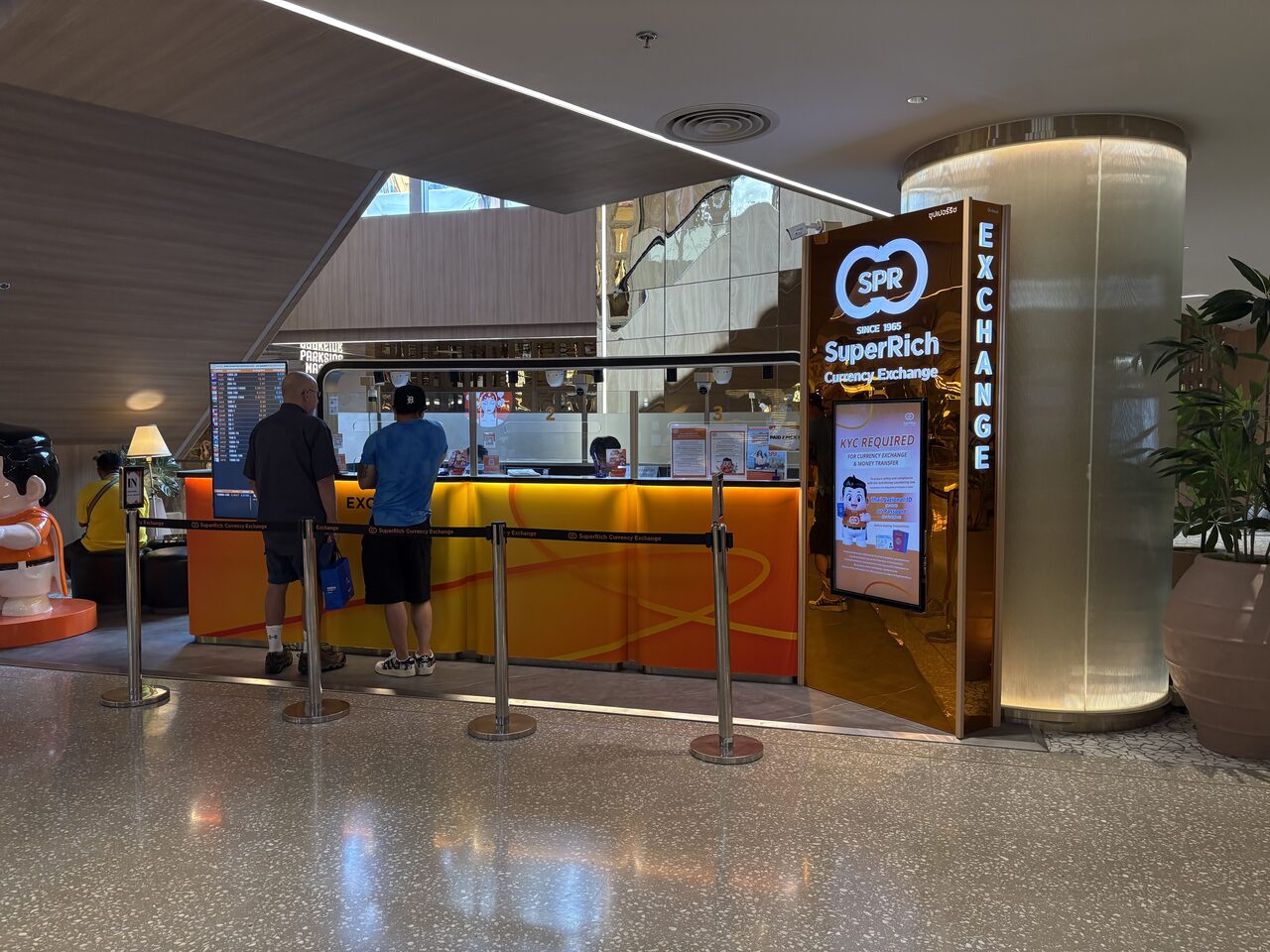
Money exchange Thailand: four rates for one currency
Thai exchange houses price banknotes by how easily they can ship them back. Big notes are cheap to handle, small notes are not, and the gap shows up on the board. These were the buying rates at SuperRich on 7 October 2026.
| Note | Baht per unit | Gap vs the top rate |
|---|---|---|
| USD 100 and USD 50 | 33.61 | — |
| USD 20 and USD 10 | 33.55 | −0.06 |
| USD 5 | 33.50 | −0.11 |
| USD 1 | 33.35 | −0.26 |
| EUR 500–100 | 37.70 | — |
| EUR 50–5 | 37.65 | −0.05 |
| GBP 50 | 44.45 | — |
| GBP 20–5 | 44.40 | −0.05 |
What the denomination gap is worth on $1,000
Run the same $1,000 through the board in different notes and the Thai baht exchange you walk out with changes like this.
| What you hand over | Baht received | Lost vs hundreds |
|---|---|---|
| 10 × $100 | 33,610 | 0 |
| 50 × $20 | 33,550 | 60 |
| 200 × $5 | 33,500 | 110 |
| 1,000 × $1 | 33,350 | 260 |
So the honest answer is: worth doing, not worth stressing about. Asking your bank at home for hundreds instead of twenties buys you 60 baht per $1,000 — a bottle of water and a bowl of noodles. Euro and sterling tiers are thinner still, around 50 baht per 1,000 units. The denomination rule is real, it is just not where the money is.
Where you change it costs ten times more
This is the part that moves real money. The same $1,000, in the same crisp hundreds, priced by typical margins at each kind of counter in Bangkok:
| Where you change it | Typical margin | Baht for $1,000 | Lost vs mid-market |
|---|---|---|---|
| SuperRich Thailand, Vasu, city booths | 0.1–0.3% | ~33,610 | ~50 |
| SuperRich counter, Suvarnabhumi B floor | 0.6–0.7% | ~33,440 | ~220 |
| Thai bank branch in town | 1.0–2.0% | ~33,160 | ~500 |
| Mall and tourist-strip booths | 1.5–2.5% | ~32,990 | ~670 |
| Hotel front desk | 4.0–6.0% | ~31,980 | ~1,680 |
| Bank counter, airport arrivals hall | 5.0–7.0% | ~31,640 | ~2,020 |
From the top row to the bottom is 1,970 baht on a single $1,000 exchange, roughly $59. That is about thirty plates of cheap food in Bangkok, or very nearly a whole extra day against an average cost per day Thailand-wide of 1,500–2,500 baht for mid-range travellers. The note in your hand is worth 60 baht. The door you walk through is worth almost two thousand.

The airport play: change 2,000 baht, then ride into town
You still need baht the moment you land, so change a little and move on. Two thousand baht covers the 45-baht Airport Rail Link ticket from Suvarnabhumi airport transit level into the city, a taxi at the far end and a first meal. Do the serious exchange the next morning at a city booth; our guide to SuperRich at Phaya Thai covers the branch that sits one escalator from the rail line, and the Thai baht exchange page tracks the main Bangkok counters.
The rule that voids all of the above: note condition
Thai booths are fussy in a way that catches people out. A $100 bill issued from 2013 with the blue 3-D ribbon gets the posted rate. The older white-design hundreds from 1996 to 2012 are often discounted by 0.2–0.5 baht per dollar, and pre-1996 notes are frequently refused outright. Tears, tape, ink, stamps, a handwritten note in the margin — any of those and the cashier slides it back across the counter.
Thai bank branches are more forgiving with tired notes but price them worse anyway. Pack your cash flat, bring your passport for the ID check, and count what you are handed before you leave the window.
Thailand ATM fees versus cash in 2026
The alternative to carrying cash is pulling baht from a machine, and that has its own fixed cost. Every major Thai bank charges a flat 220 baht per foreign-card withdrawal — AEON is the outlier at 150 — with per-withdrawal caps of 20,000 to 30,000 baht, so $1,000 means two trips to the machine.
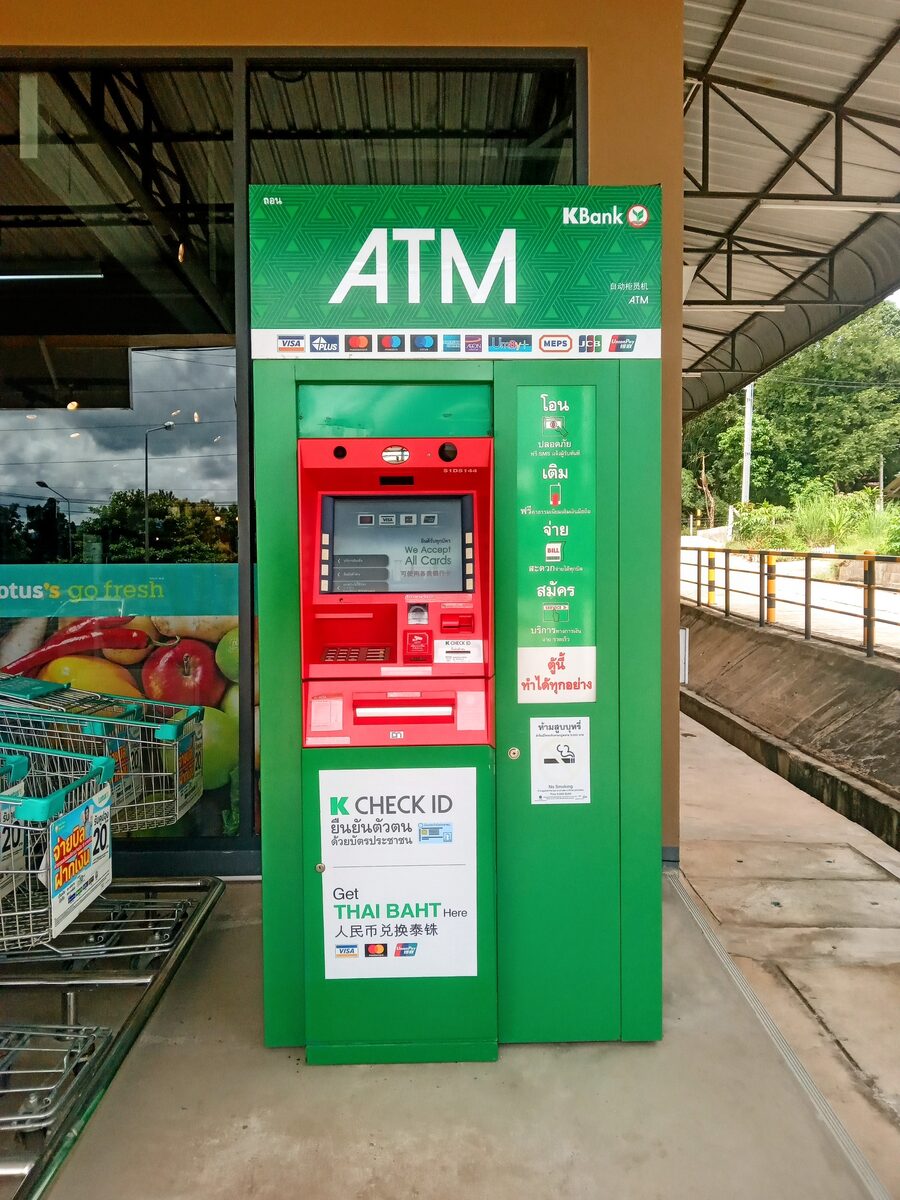
| Getting 33,000-odd baht | Fees | Baht in hand |
|---|---|---|
| Crisp hundreds at a city booth | none | ~33,610 |
| Fee-reimbursing card (e.g. Schwab) | 440 refunded later | ~33,600 |
| Wise or Revolut, 2 withdrawals | ~170 + 440 | ~33,050 |
| Ordinary card with 1% FX markup | ~337 + 440 | ~32,880 |
Whichever route you pick, refuse dynamic currency conversion. When a terminal offers to bill you in your home currency it is adding 3–7 per cent for the privilege — always choose Thai baht. Our Thailand ATM fees guide and the cash-or-card comparison run the numbers in full.
Bottom line: your money exchange Thailand savings summary
- Bring hundreds, not twenties. Worth 60 baht per $1,000, and 260 if the alternative is singles. Free to do, so do it.
- Bring them clean and recent. 2013-onward hundreds get the posted rate; taped, torn or marked notes get refused.
- Change 2,000 baht at the airport, no more. That covers the 45-baht rail link and your first night.
- Do the real exchange at a city booth. SuperRich, Vasu and the like sit 0.1–0.3% off mid-market against 5–7% in the arrivals hall — about 1,970 baht on $1,000.
- Never the hotel desk. 4–6% for the convenience of not walking two hundred metres.
- Withdraw big or not at all. The 220-baht Thailand ATM fee is 7.3% on a 3,000-baht withdrawal and 1.1% on 20,000.
- Always decline DCC. Pay in baht, every time.
Do all of that and a $1,000 holiday float turns into roughly 33,600 baht instead of 31,600 — two thousand baht of Thailand travel costs recovered before you have bought anything. Put your own figures in with our Thailand trip budget estimator.
Money exchange Thailand: quick answers
Do $100 bills really get a better rate in Thailand?
Yes, but modestly. At SuperRich on 7 October 2026 a USD 100 or 50 note bought 33.61 baht, a USD 20 or 10 bought 33.55, a USD 5 bought 33.50 and a USD 1 bought 33.35. On $1,000 that is a 60-baht gap between hundreds and twenties and a 260-baht gap between hundreds and singles. Euro and sterling tiers are narrower, around 50 baht per 1,000 units.
Where do I get the best money exchange Thailand rate?
City exchange houses. SuperRich Thailand, SuperRich 1965, Vasu and similar operators run 0.1–0.3 per cent off mid-market, against 1–2 per cent at a Thai bank branch, 4–6 per cent at a hotel desk and 5–7 per cent at a bank counter in the airport arrivals hall. On $1,000 the spread between best and worst is close to 1,970 baht.
Should I change money at Suvarnabhumi airport?
Only a small amount. The SuperRich counter on the B floor by the Airport Rail Link is far better than the arrivals-hall bank counters, but still worse than town. Change 1,000–2,000 baht to cover the 45-baht train, a taxi and a meal, then use a city booth the next day.
Is it cheaper to use an ATM or exchange cash in Thailand?
Cash in crisp hundreds at a city booth usually wins. Thai ATMs charge a flat 220 baht per foreign-card withdrawal (AEON 150) with caps of 20,000–30,000 baht, so $1,000 costs 440 baht in machine fees before your own bank’s markup. Only a card that reimburses ATM fees, such as Charles Schwab, matches the booth.
Work out what this costs you
Rules and fees change; your budget should keep up. Estimate your Thailand trip budget — flights, rooms, food and transport in baht and your own currency, in about two minutes.
Build my Thailand budget →Source:
Reporting this piece draws on. Rules change — check the primary source before you act on anything here.
- SuperRich Thailand - Live exchange rate board: USD, EUR and GBP buying rates by banknote denomination (cited in article dated: 2026-10-07)
- Grand SuperRich - Daily rate sheet: USD 100/50, 20/10, 5 and 1 buying rates in Thai baht (cited in article dated: 2026-10-07)
- Thailand Starter Kit - Currency exchange in Thailand 2026: booth spreads, bank rates and airport margins compared (cited in article dated: 2026-10-07)
- Off Path Thailand - Best money exchange Bangkok 2026: margins by venue and what to avoid (cited in article dated: 2026-10-07)
- Senate Exchange - Exchanging dollars in Thailand: which bills are discounted or refused (cited in article dated: 2026-10-07)
- Thailand Knowledge - Thailand ATM fees 2026: every bank's foreign-card charge and withdrawal limits (cited in article dated: 2026-10-07)
- Wise - Live USD to THB mid-market rate (cited in article dated: 2026-10-07)
Published 7 October 2026. Travel rules, fees and prices change without much warning — always confirm with an official source or your embassy before you book or travel. Nothing here is legal, immigration or financial advice.