
A litre of safe drinking water in Thailand costs 1 baht from the blue machine on the street corner and up to 133 baht from the fridge in your hotel room. Near enough the same water. Roughly 130 times the money.
Water is the line in Thailand travel costs that nobody budgets for and everybody pays, two or three times a day, for the whole trip. You cannot drink the tap water, the heat means you will get through two to three litres a head daily, and a cold bottle is priced exactly as highly as the moment you want it. This budget travel guide puts 2026 baht figures on every way of buying drinking water in the country, explains the coin-operated refill machines that almost every visitor walks straight past, and works out what the swap is worth to a couple over a fortnight. At 33.5640 baht to the US dollar on 6 November 2026, every figure below is in baht first.
Thailand travel costs for water: the 2026 per-litre table
Shops quote water by the bottle, which hides the only number that matters. Convert everything to baht per litre and the spread stops looking like small change.
| Where you buy it | Typical price | Per litre (THB) | Per litre (USD) |
|---|---|---|---|
| Coin refill machine, your own bottle | 1 THB per litre | 1.0 | $0.03 |
| Street market cart, small bottle | 3–6 THB | 5–10 | $0.15–0.30 |
| Supermarket 6-litre jug | 35–50 THB | 5.8–8.3 | $0.17–0.25 |
| 7-Eleven, 1.5-litre bottle | 13–15 THB | 8.7–10.0 | $0.26–0.30 |
| 7-Eleven, 600 ml bottle | 7–10 THB | 11.7–16.7 | $0.35–0.50 |
| Restaurant or bar, small bottle | 20–40 THB | 33–67 | $0.99–2.00 |
| Hotel minibar, small bottle | 40–80 THB | 67–133 | $2.00–3.96 |
Nothing else in a Thai budget moves by a factor of 130. A taxi is perhaps four times a bus; a restaurant plate is four or five times a food court plate, the arithmetic behind our 7-Eleven price guide. Water beats all of it, because the cheapest option is a public utility sold at cost and the dearest is a fridge you opened at two in the morning.
The 1-baht refill machine, and how to actually use one
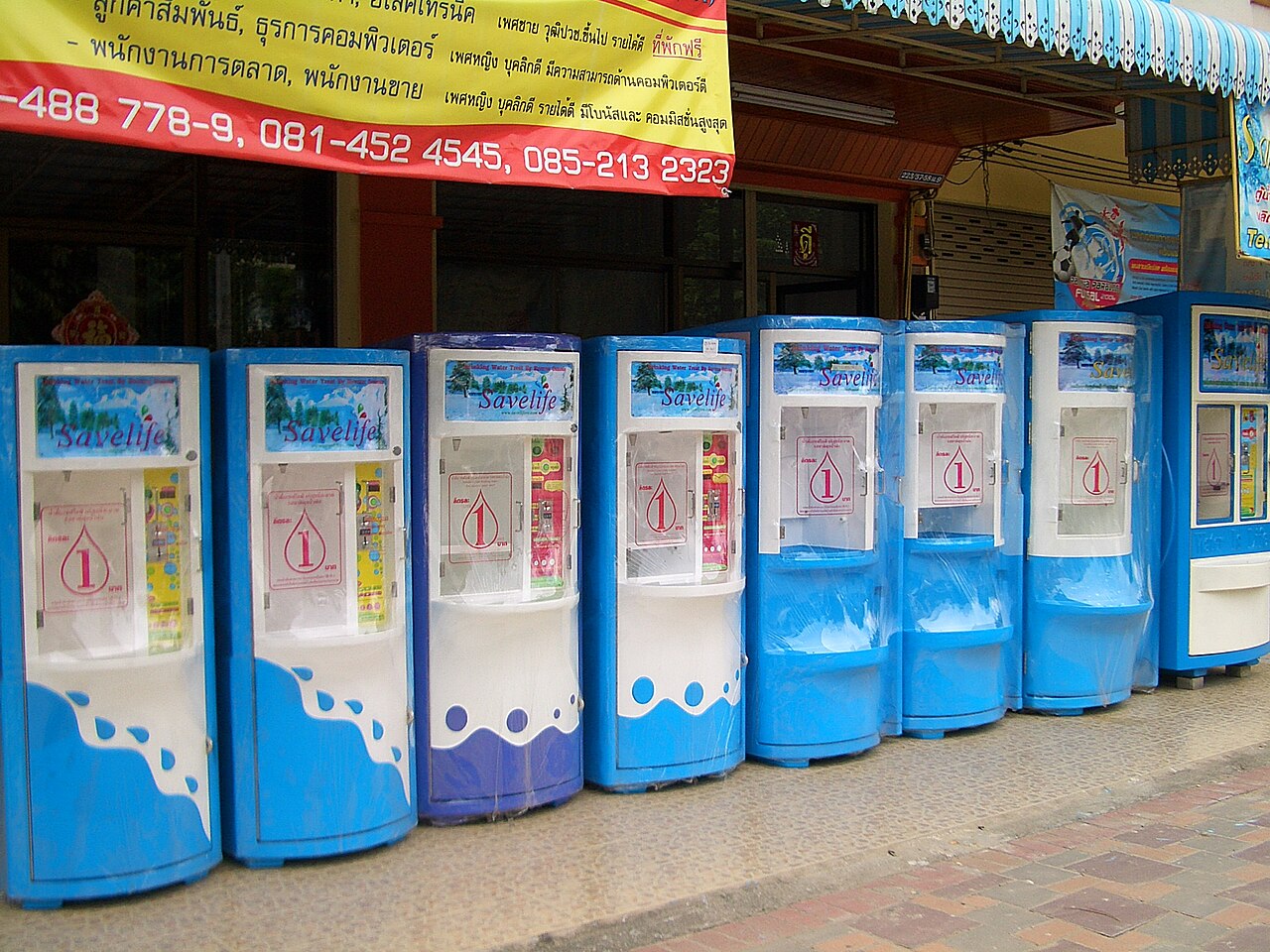
They are the blue-and-white cabinets standing in rows outside convenience stores, at the mouths of sois, beside markets and near station exits. Thais use them constantly and tourists almost never, because nothing on them is in English and they look like an appliance rather than a shop.
The routine takes fifteen seconds. Bring your own empty bottle, put it under the nozzle, drop a coin in the slot, press the button. One baht buys a litre; some machines give 1.5 litres for the coin, some older ones take 50 satang, and a few newer ones want 2 baht. They accept 1, 2, 5 and 10-baht coins, and they filter and treat the mains supply on the spot rather than storing it.
If you did not bring a bottle, an empty one costs 10 to 20 baht and pays for itself in a day and a half. That single purchase is the most profitable thing most visitors do all trip, the rare Thailand travel costs decision that pays back in forty-eight hours, and it belongs near the top of any list of Thailand travel tips.
Use the busy machines. Maintenance varies from excellent to indifferent, and a machine nobody uses is a machine nobody services. Pick one outside a working 7-Eleven or a market where people are queueing, glance at the nozzle before you fill, and give the first couple of seconds of flow a miss. If a machine looks neglected, walk to the next one — in most Thai neighbourhoods it is thirty metres away.
Where bottled water quietly inflates your Thailand travel costs
Three places charge tourist prices for an ordinary commodity, and all three are easy to avoid.
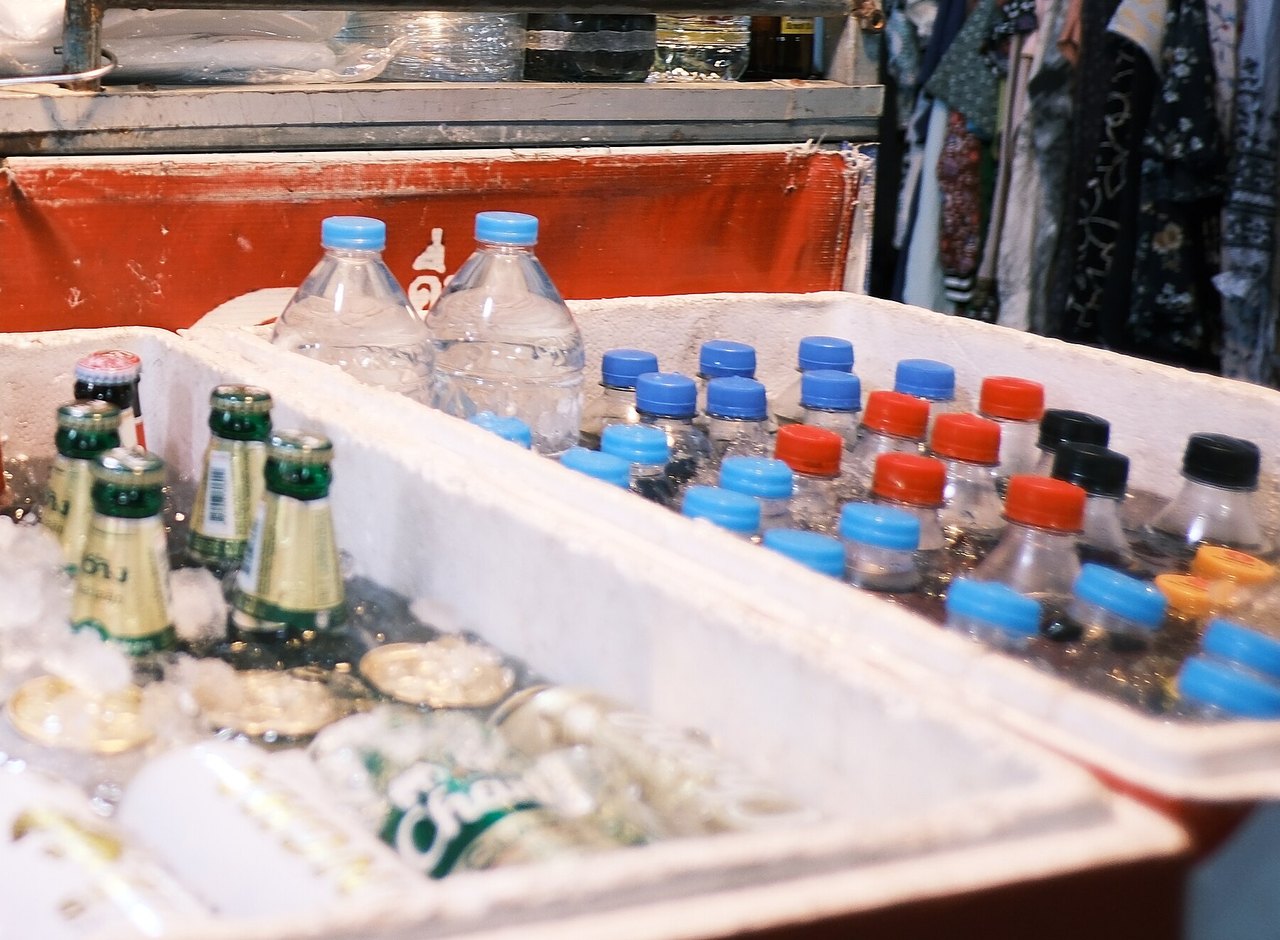
The hotel room. Most Thai hotels leave one or two free bottles a day; the minibar behind them charges 40 to 80 baht for the same 600 ml that sells for 7 baht in the shop downstairs. Drink the free ones, refill before you go out, and treat the minibar as decoration.
The restaurant table. A sealed bottle brought to your table runs 20 to 40 baht, about 33 to 67 baht a litre. Ordering tap water is not an option in Thailand, so this is simply the cost of drinking with a meal — but it is a reason to arrive carrying your own and order one bottle rather than four.
Airside and the tourist strips. Anywhere you cannot leave to buy it, water is priced like a captive sale. We costed the terminals separately in our guide to food and drink prices at Suvarnabhumi; the short version is to fill an empty bottle after security rather than buy one.
Can you drink tap water in Thailand?
The honest answer is more interesting than the usual flat no. The Metropolitan Waterworks Authority, which supplies Bangkok, Nonthaburi and Samut Prakan, states in its own public Q&A that its water is clean, safe and drinkable, produced to World Health Organization guidance, with free residual chlorine of 0.2 to 1.2 mg per litre measured in the distribution network.
What leaves the treatment plant and what arrives at your tap are different things. The pipework is old in places, most buildings pull from rooftop or basement storage tanks that are cleaned on nobody's particular schedule, and the authority itself tells customers to maintain their own plumbing and replace corroded iron pipe. Nationwide, only around 250 areas are confirmed as having tap water fit to drink straight, and one estimate puts the share of Bangkok residents who drink from the tap at roughly one in ten. Every travel guide says don't, and for a two-week trip that is the right call: the downside is a ruined week, and the upside is 84 baht — the smallest line in anyone's Thailand travel costs.
Ice is a different question
Ice in Thailand is overwhelmingly factory-made from treated water and delivered in sealed bags — the cylindrical cubes with a hole through the middle are the tell. In restaurants, cafés and bars in any town you are likely to visit, it is fine. A bag of it costs 7 to 8 baht at a convenience store if you are keeping your own bottles cold.
The fortnight maths: what the swap is worth
Two people, fourteen days, three litres each a day. That is 84 litres over the trip, and here is what those 84 litres cost by route.
| How you buy your water | Cost of 84 litres | In USD |
|---|---|---|
| Refill machines, plus two 20-baht bottles | 124 THB | $3.69 |
| 7-Eleven 1.5-litre bottles at 14 THB | 784 THB | $23.36 |
| Supermarket 6-litre jugs at 42 THB | 588 THB | $17.52 |
| Restaurant bottles and the minibar, at 50 THB a litre | 4,200 THB | $125.13 |
Against convenience-store bottles the refill habit saves 660 baht, about $19.66. Against the lazy route of restaurant bottles and the minibar it saves 4,076 baht, about $121.44 — two nights in a decent Bangkok hotel room, or a domestic flight, for a change of habit that costs nothing. Other budget travel guides reach the same ballpark from the other direction, putting a week's water at 150 to 200 baht a head on bottles, 30 to 50 from a convenience store and 15 to 25 from refill stations.
Set that beside the average cost per day Thailand figures: a frugal traveller spends roughly 1,000 to 1,500 baht a day all in. Water bought badly is a quiet 150 baht a day of that, and water bought well is 3. It is the single highest-percentage saving available in cheap travel Thailand, which is precisely why nobody writes about it.
Where the saving leaks back into your Thailand travel costs
Two things undo it. The first is coins: refill machines take nothing else, and arriving with only 1,000-baht notes means you will buy a bottle instead. Break notes at a 7-Eleven, which is also where the cheapest cold water is when you have run out, and keep a handful of 1 and 5-baht coins in a pocket — the same coins that buy a 15-baht iced coffee from a cart or the cheap food in Bangkok that street vendors price in round numbers.
The second is cash itself. Every Thai ATM adds a flat 220-baht fee or more to a foreign card withdrawal, which is 220 litres of water gone before you drink any; the detail is in our Thailand ATM fees guide. Bring notes, do your Thai baht exchange at a licensed counter such as a SuperRich Thailand branch rather than an airport kiosk, and refuse any card terminal that offers to bill you in your home currency. Our Thailand money exchange finder shows the counters nearest wherever you are staying and checks a board rate against the live one.
Bottom line: the savings summary
Buy one reusable bottle on day one, learn to spot the blue machines, and the water line in your Thailand travel costs effectively disappears.
| Swap | You pay | Instead of | You save |
|---|---|---|---|
| Refill machine vs 7-Eleven, per litre | 1 THB | 9–10 THB | 8–9 THB ($0.27) |
| Refill machine vs hotel minibar, per litre | 1 THB | 67–133 THB | up to 132 THB ($3.93) |
| Two people, 14 days, vs convenience store | 124 THB | 784 THB | 660 THB ($19.66) |
| Two people, 14 days, vs restaurants and minibar | 124 THB | 4,200 THB | 4,076 THB ($121.44) |
| Reusable bottle, bought once | 10–20 THB | — | Pays for itself in two days |
None of this is a sacrifice. You drink exactly as much water, just as cold if you keep a bottle in the room fridge, and the only thing you give up is the habit of buying it at the worst possible moment from the nearest possible fridge. Drop your own numbers into our free Thailand trip cost calculator and see what a fortnight of 1-baht litres does to the bottom of a Thailand budget travel plan.
Work out what this costs you
Rules and fees change; your budget should keep up. Estimate your Thailand trip budget — flights, rooms, food and transport in baht and your own currency, in about two minutes.
Build my Thailand budget →Source:
Reporting this piece draws on. Rules change — check the primary source before you act on anything here.
- ThailandKnowledge - Drinking Water Safety in Thailand 2026, published and last verified March 2026: a 1.5-litre bottle at 7-Eleven 7-15 baht, street market cart bottles 3-6 baht, coin-operated blue refill stations 1 baht per litre; tap water not safe to drink directly in most areas (cited in article dated: 2026-11-07)
- InfoBangkok - Bangkok Water Safety: Tap, Bottled & Ice Guide, updated April 2026: 7-Eleven 600 ml 7-10 baht and 1.5 litre 13-15 baht, supermarket 6-litre jugs 35-50 baht, restaurant small bottle 20-40 baht, water vending machines 1 baht per litre into your own bottle, hotels typically providing one or two free bottles a day (cited in article dated: 2026-11-07)
- BackpackThailand - Is Tap Water Safe in Thailand? A City-by-City Breakdown, published and updated 22 February 2026: refill stations 1 baht per litre with an empty bottle at 10-20 baht, collapsible bottles 200-500 baht, filter bottles 500-2,000 baht; weekly water spend of 150-200 baht on bottled water, 30-50 baht buying from 7-Eleven and 15-25 baht using refill stations (cited in article dated: 2026-11-07)
- It's Better in Thailand - Can you drink tap water in Thailand?: 7-Eleven 600 ml 7-10 baht and 1.5 litre 12-15 baht, restaurant and tourist-area bottles 20-40 baht, hotel minibar 40-80 baht against 7 baht downstairs, refill stations 1 baht per litre and sometimes 1 baht per 1.5 litres, delivered 18.9-litre jugs 30-50 baht; around 250 areas nationwide confirmed by the Provincial Waterworks Authority as having drinkable tap water, and an estimate that about 10 per cent of Bangkok residents drink from the tap (cited in article dated: 2026-11-07)
- Metropolitan Waterworks Authority - water FAQ (Thai), page published 18 November 2022 and modified 26 January 2026: the MWA states its tap water is clean, safe and drinkable, produced in line with World Health Organization guidance, with a residual free chlorine target of at least 0.2 mg per litre and measured levels of 0.2-1.2 mg per litre in the distribution network, while advising customers to keep household pipes and storage tanks clean and replace corroded iron pipe (cited in article dated: 2026-11-07)
- Perfect Homes - Drinking Water in Chiang Mai, A Survival Guide (undated): refill machines charging 1 baht or 50 satang for a litre and accepting 1, 2, 5 and 10-baht coins; 1.5-litre bottled water from 9 baht for a supermarket own brand to 24 baht for a premium brand; 6-litre bottles from 26 to 59 baht; ice bags at convenience stores 7 to 8 baht (cited in article dated: 2026-11-07)
- Wikipedia - Metropolitan Waterworks Authority: the state enterprise supplying Bangkok, Nonthaburi and Samut Prakan, treating raw water from the Chao Phraya River and the Mae Klong Dam at four plants, with roughly 37,700 km of distribution pipe (cited in article dated: 2026-11-07)
- Trading Economics - Thailand currency: USD/THB at 33.5640 baht per US dollar quoted for 6 November 2026, with GBP/THB at 44.8307 and EUR/THB at 37.4082 (cited in article dated: 2026-11-07)
Published 7 November 2026. Travel rules, fees and prices change without much warning — always confirm with an official source or your embassy before you book or travel. Nothing here is legal, immigration or financial advice.