
The 135 kilometres from Chiang Mai to Pai cost 220 baht at the counter and up to 355 baht on a booking site, and it is the same white minivan with the same roof rack either way. Route 1095 is the most famous stretch of tarmac in the north — 762 curves through the Mae Taeng hills — and it is also one of the easiest places in Thailand budget travel to pay 60 per cent over the odds before you have even sat down.
This budget travel guide prices the whole run for November 2026: the counter fare, the online markup, the hotel-pickup vans, the scooter, the private car, and what a day in Pai actually costs once the van drops you on Chaisongkram Road. At 33.77 baht to the US dollar, the cheap version of this leg is about $6.50 a head.
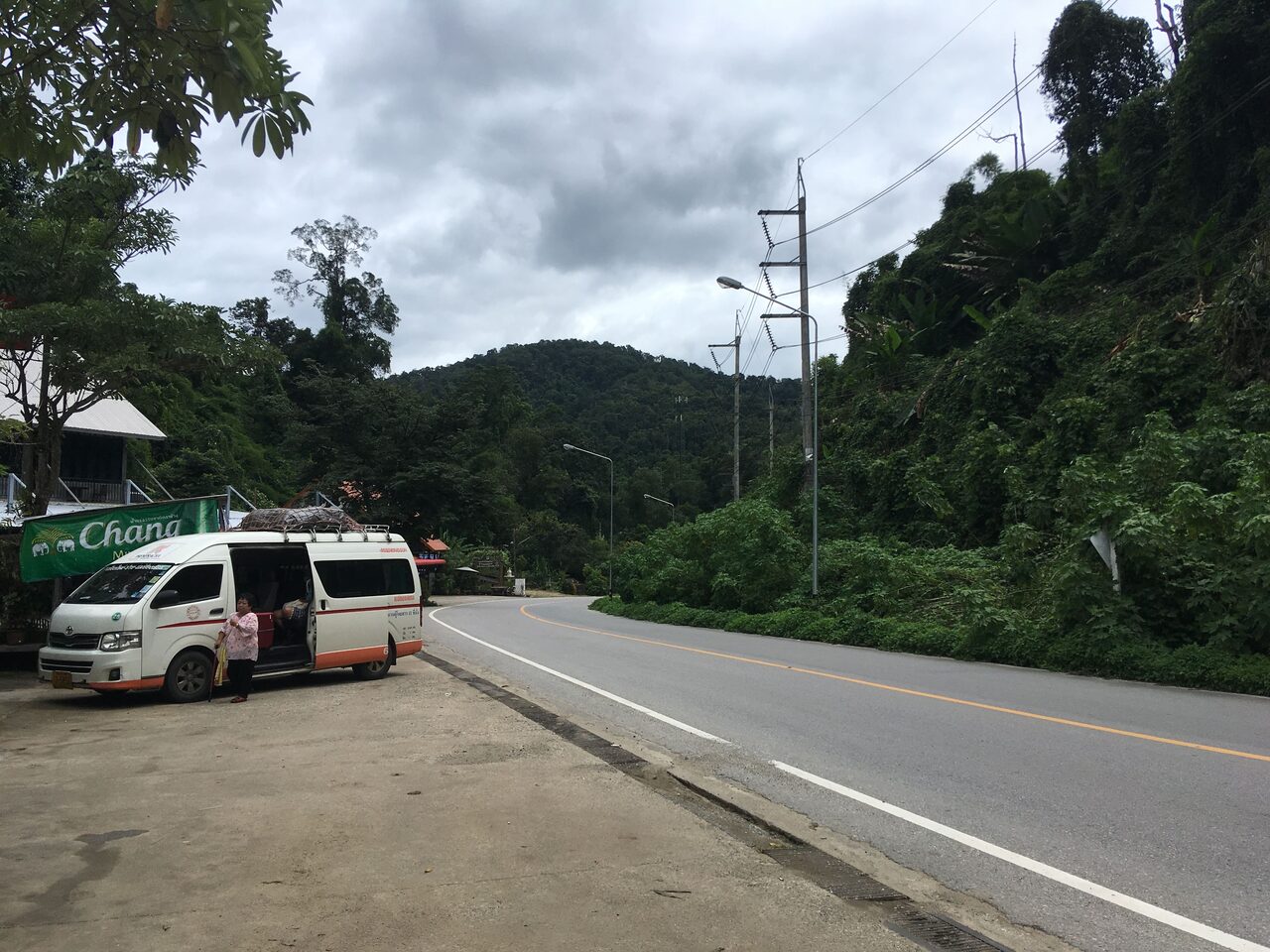
Thailand budget travel on Route 1095: every Chiang Mai to Pai fare
Prempracha Transport has run this corridor for years. Its vans leave Arcade — officially Chiang Mai Bus Terminal 2 — roughly hourly from 06:30 to 17:30, and come back from Pai bus station hourly from 07:00 to 17:30. The timetable allows four hours twenty; in practice it is three and a half to four, including the comfort stop. Aya Service runs a smaller fleet of about seven vans a day from its Kham Thiang Plaza office between 08:30 and 14:30, and charges more because it collects you from your hotel.
Read the units before you compare the rows. The first five are per person. A private car or van is one price for the whole vehicle, which changes the arithmetic completely if there are four of you.
| Option | Cost (THB) | Time | Notes |
|---|---|---|---|
| Prempracha van, bought at the Arcade counter | 150–220 per person | 3.5–4 hr | Hourly 06:30–17:30; cash only |
| The same van, booked through a resale site | 270–355 per person | 3.5–4 hr | Identical seat, identical driver |
| Aya Service van with hotel pick-up | 250 at the office, ~280 online | ~3.5 hr | Seven a day, 08:30–14:30 |
| Old City tourist vans | 500–900 per person | 3–4 hr | Sold by agents, not operators |
| Scooter, rented in Chiang Mai | 200–300 per day + fuel | 3.5–5 hr | One-way drop fee is extra and unpublished |
| Private car with driver | 2,100–4,000 per vehicle | ~3 hr | Nine-seat vans quoted to 6,700 |
| Tout’s “private taxi” near the Old City | 3,000+ per vehicle | ~3 hr | Same cars, worse price |
Thai baht exchange, cash, and why the counter beats the booking site
The gap is 135 baht — about $4.00 — for a seat on a van that was always going to Pai whether you booked it or not. Return, that is 270 baht, or roughly what three bowls of khao soi cost on Pai Walking Street. The resale sites earn it by holding inventory you can walk up and buy yourself, and in April, over New Year and from November to February they genuinely do sell out, which is the one week of the year the markup buys you something real.
The catch for anyone arriving straight off a flight is that the Arcade counter takes cash. Thai baht exchange matters here in a way it does not when everything goes on a card: if you pull 220 baht of van fare out of a Thai ATM you will have paid the standard 220-baht foreign-card fee on top of it, effectively doubling the fare. Change money before you travel north at a licensed booth — SuperRich Thailand and the Chiang Mai chains that compete with it post their rates on the window — decline the machine when it offers to bill you in your home currency, and check what the booths are paying with our Thailand baht rate checker before you hand anything over. A 220-baht card fee on a 220-baht fare is the sort of round number that quietly undoes a week of Thailand budget travel discipline.
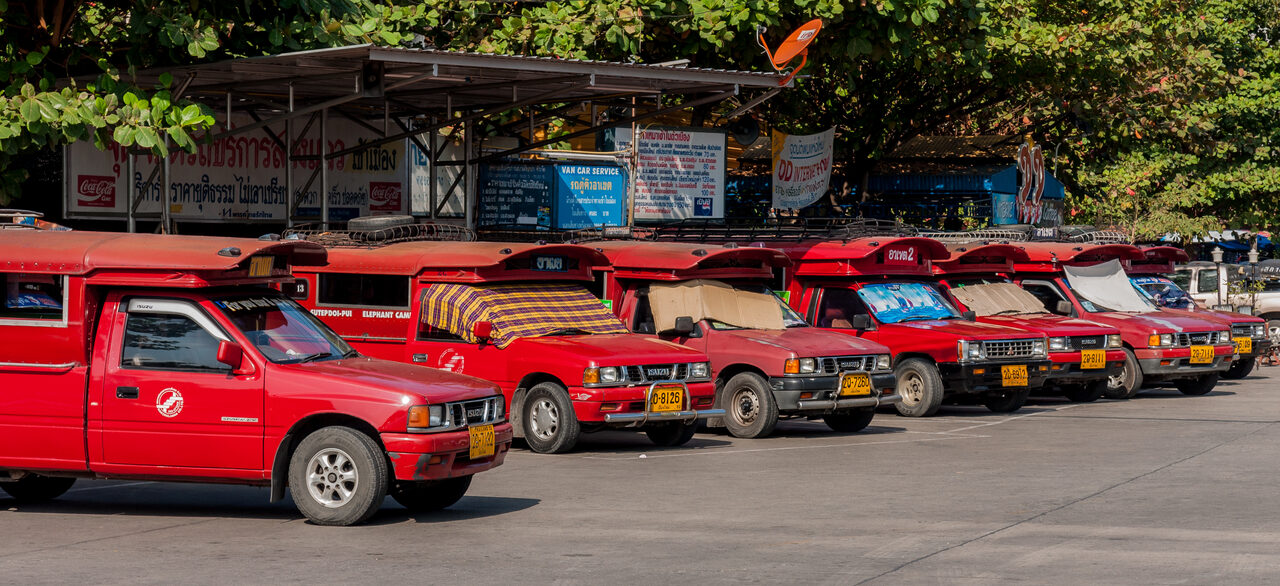
Getting to Arcade for 30 baht instead of 150
Arcade sits about five kilometres north-east of the Old City, and how you cover those five kilometres can cost more than a fifth of the van fare. A shared red songthaew flagged on the street is 30 baht a head. A Grab or a tuk-tuk from the moat is 100 to 150 for the vehicle. Agents working the Old City will sell you the Pai ticket without the walk, at roughly 200 baht over the counter price. Two people taking the songthaew and buying at the window save about 340 baht return against the comfortable version — a night in a riverside bamboo hut in Pai, more or less.
Scooter, private car or van: the per-person arithmetic
Group size is the single biggest lever on Thailand travel costs over this road, and the private car looks absurd at 2,100 baht until you divide it. Four people splitting a car pay 525 each, which is within 300 baht of the hotel-pick-up van and gets you three hours with stops where you want them. Below four passengers the maths never works: a couple pays 1,050 a head against 220 at the counter, a difference of 1,660 baht each way, or about $49.
The scooter is the option most people romanticise and most people should skip for this particular road. A 125cc automatic is 200 to 300 baht a day, and the ride itself is free beyond fuel — but the drop fee for leaving the bike in Pai is quoted at the counter rather than published, hospitals along 1095 see a steady trade in gravel rash, and the rental shop holds a 1,000 to 3,000 baht cash deposit. Rent in Pai instead, where the same bike is 150 to 250 a day and the roads are flat.
Whichever van you take, two small fees catch people out. Bags go on the roof under a 15 kg limit, and strapping an oversized one down is about 50 baht. Travel-sickness tablets are 10 to 40 baht a strip from any pharmacy, and on 762 curves they are the best-value purchase of the entire trip.
Cheap food in Pai: what the town costs once you arrive
Pai is where Thailand budget travel stops feeling like a compromise. It is cheaper than Chiang Mai and dramatically cheaper than the islands, which is why people who planned three nights stay three weeks. On Walking Street a bowl of khao soi is 50 to 70 baht, a length of sai ua 30 to 50, roti with egg 30 to 40, and most stall plates land between 40 and 80. A large Chang is 80 to 100. Sit-down restaurants on the main road charge 150 to 300 for the same food under a roof.
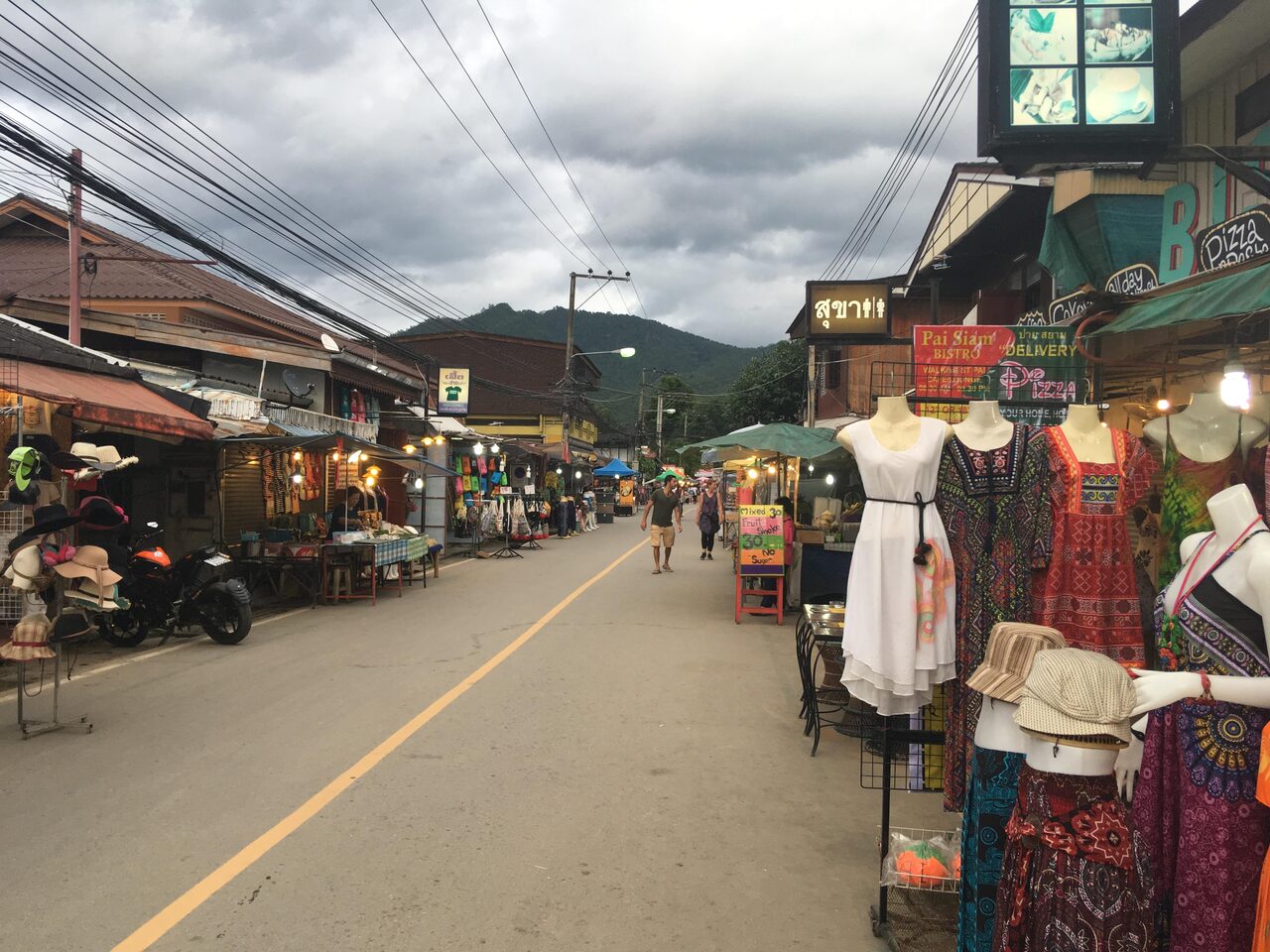
Sleeping is where Pai really undercuts the rest of the country: a bamboo hut by the river starts around 500 baht a night, against 2,000 for a boutique resort room and 5,500 at the top end. Most of the scenery is free or nearly so — Pai Canyon costs nothing, Yun Lai viewpoint is 20 baht, the bamboo bridge 30. Two-tier pricing shows up at the hot springs, where Tha Pai asks foreigners about 300 baht against roughly 40 for Thai nationals; Sai Ngam, further out, is about 200 plus 20 for the scooter. In-town songthaews to the outlying resorts are 50 to 150 a trip.
Add it up and a day in Pai — hut, three meals from the stalls, a rented scooter and a viewpoint or two — comes to roughly 1,000 baht, about $30. The average cost per day Thailand-wide for a budget traveller sits nearer 1,500 to 2,500 baht, so the town pays for its own minivan fare inside forty-eight hours. Our free Thailand trip cost calculator will fold those numbers into the rest of your itinerary.
Thailand travel tips for the 762 curves
Three practical notes. Mobile coverage on 1095 is patchy for about forty minutes in the middle, so download your map before you leave Chiang Mai — a local SIM card Thailand-wide gives you data almost everywhere else, but not in the Mae Taeng gorges. Sit in the front half of the van if you are prone to motion sickness, and ask for a window. And if you are connecting from Bangkok, work backwards: Suvarnabhumi airport transit plus a domestic hop to Chiang Mai plus the last van means you want a mid-morning Pai departure, not the 17:30, because arriving in the dark on an unlit mountain road is how a 220-baht saving turns into a 600-baht taxi from the bus station to a guesthouse you cannot find.
Fares on this route are not published by the operators in any central place, and the counter price has drifted upward through 2026 — travellers reported 150 baht in 2024 and 220 to 250 this year. Treat the figures here as the realistic range rather than a guaranteed price, and expect sellouts from November to February and over Songkran.
Bottom line: the Thailand budget travel savings summary
- Buy at the Arcade counter, not online: 220 baht against 270–355, saving 50–135 baht each way, or up to 270 baht return (about $8).
- Take a 30-baht songthaew to the terminal: saves 70–120 baht against a Grab or tuk-tuk, each way.
- Skip the Old City agents: their markup on the identical ticket is roughly 200 baht a person.
- Only charter a car at four passengers or more: below that it costs 1,660 baht a head more than the van.
- Rent the scooter in Pai, not in Chiang Mai: 150–250 a day there against 200–300 plus an unpublished one-way drop fee.
- Carry cash: the counter takes no cards, and a cash machine withdrawal to cover the fare adds a 220-baht foreign-card charge.
Done the cheap way, a return trip from Chiang Mai to Pai including the rides to and from the terminal costs 500 baht, or $14.81. Done the comfortable way it costs 1,010. Done by private car on your own it costs 4,200. The road, the view and the 762 curves are identical in all three, which is the whole argument for Thailand budget travel in a single sentence.
Work out what this costs you
Rules and fees change; your budget should keep up. Estimate your Thailand trip budget — flights, rooms, food and transport in baht and your own currency, in about two minutes.
Build my Thailand budget →Source:
Reporting this piece draws on. Rules change — check the primary source before you act on anything here.
- Visit Thailand Today - Chiang Mai to Pai guide, updated 19 October 2026: Prempracha counter fare 150-220 baht and 270-355 baht through online sellers, Aya Service van with hotel pick-up 250 baht (about 280 via 12Go), Old City tourist vans 500-900 baht, private car 2,100-4,000 baht and a nine-seat van to 6,700, scooter from 200 baht a day, Prempracha departures hourly 06:30-17:30 from Arcade (Chiang Mai Bus Terminal 2) and 07:00-17:30 from Pai, Aya 08:30-14:30, journey 3.5-4 hours against a 4h20 timetable, 15 kg roof-rack limit (cited in article dated: 2026-11-01)
- Thailand Traveler - Chiang Mai to Pai minivan tickets, 28 September 2026: Prempracha shared van 220 baht and minibus 260 baht, online totals from about 260 baht after fees, private transfers 2,500-4,200 baht per vehicle, about four hours realistic once boarding and the rest stop are counted, Arcade check-in and Aya check-in at Kham Thiang Plaza (cited in article dated: 2026-11-01)
- Destination Thailand - Chiang Mai to Pai costed, August 2026: shared minivan 150-250 baht at the counter and 260-360 baht online with hotel pick-up, private car 2,000-3,000 baht, scooter 200-300 baht a day plus an unstated one-way drop fee, scooter rental in Pai 150-250 baht a day, Pai songthaew 50-150 baht a trip, travel-sickness tablets 10-20 baht a strip, 135 km of Route 1095 with 762 curves in 3-3.5 hours including one 15-minute stop (cited in article dated: 2026-11-01)
- Destination Thailand - Pai budget itinerary with real baht prices, November 2026: bamboo hut from 500 baht a night, boutique resort from 2,000 and top end from 5,500, khao soi 50-70 baht, sai ua 30-50, khanom jeen nam ngiao 40-60, roti with egg 30-40, large Chang 80-100, stall plates 40-80 and sit-down plates 150-300, 125cc scooter 150-250 baht a day with a 1,000-3,000 baht deposit, Pai Canyon free, Yun Lai viewpoint 20 baht, bamboo bridge 30 baht, Tha Pai Hot Springs about 300 baht foreigner against about 40 baht Thai, Sai Ngam about 200 baht plus 20 for a scooter (cited in article dated: 2026-11-01)
- Gecko Routes - Chiang Mai to Pai: Aya Service van about 246 baht and Prempracha about 250 baht as starting fares, 4 hours and 4 hours 20 minutes respectively, 762 twists and turns over about 123 km of road, Prempracha from Chiang Mai Arcade 2 to Pai Bus Station and Aya from Srimongkol Road to its Chaisongkram Road office, tickets scarce from November to February (cited in article dated: 2026-11-01)
- Northern Thailand travel guide - Chiang Mai to Pai by van: Prem Pracha Transport from Arcade Bus Terminal 2 with 12 departures each way hourly from 06:30 to 17:30, about 3 hours over 132 km, a roughly 15-minute rest stop at OK Mart and arrival at Pai Bus Station in town (fare listed at 150 baht, the older price point) (cited in article dated: 2026-11-01)
- Asia Trans Hub - Chiang Mai Bus Terminal 2 to Pai: local services quoted at 180-250 baht, 50 baht to strap an oversized bag to the roof rack, touts near the Old City marking tickets up by about 200 baht and quoting private taxis at 3,000 baht and above, tuk-tuk from Nimmanhaemin to the terminal 100-150 baht, motion-sickness tablets about 40 baht for ten (cited in article dated: 2026-11-01)
- Pound Sterling Live - USD/THB spot rate quoted at 33.7697 baht to the US dollar, the rate used for every dollar conversion in this article (cited in article dated: 2026-11-01)
Published 1 November 2026. Travel rules, fees and prices change without much warning — always confirm with an official source or your embassy before you book or travel. Nothing here is legal, immigration or financial advice.