
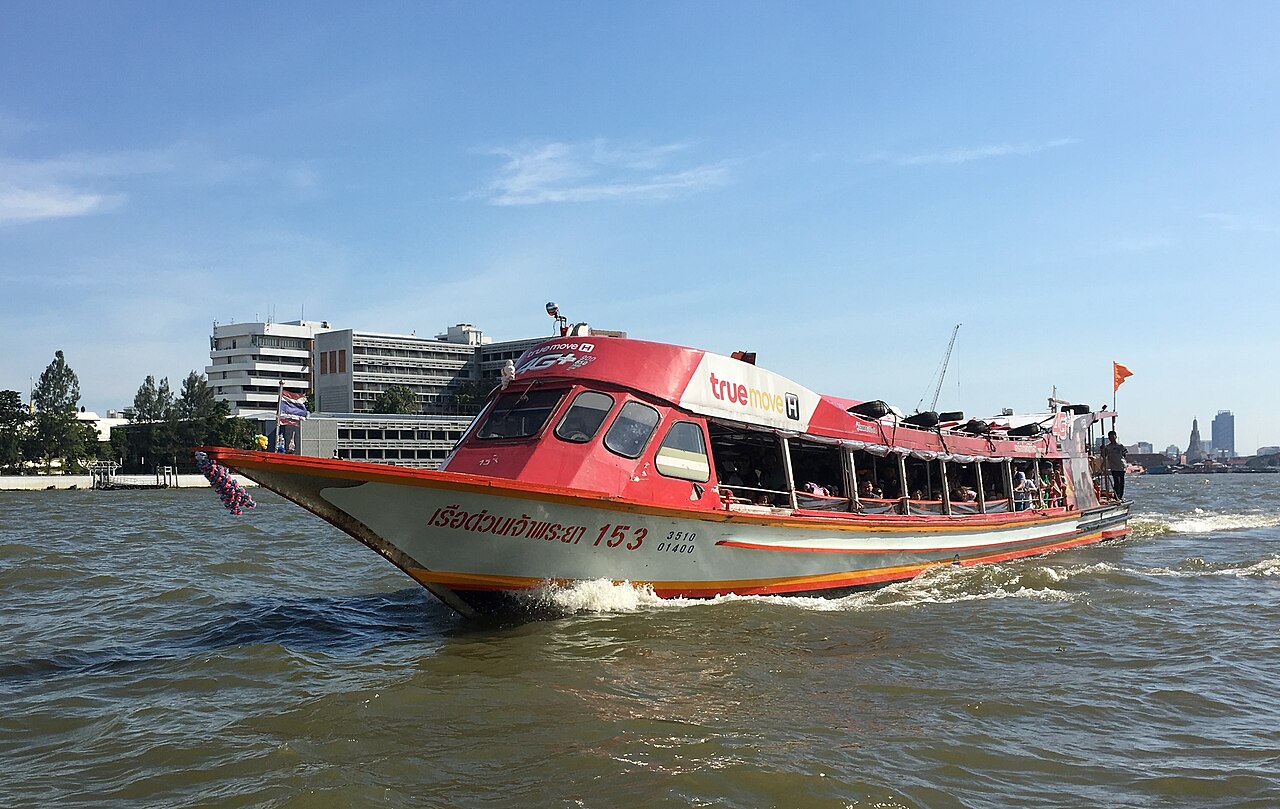
Thailand budget travel has a two-boat problem, and you can see it from one spot. Stand on Sathorn Pier in Bangkok and two vessels tie up at the same pontoon within ten minutes of each other. One is a battered commuter boat with an orange pennant charging about 20 baht. The other is a white-and-blue catamaran painted with temples, charging 40 baht a ride or 150 baht for a day pass. They run the same river, past the same temples, to almost the same piers.
This budget travel guide prices every boat on the Chao Phraya in September 2026, at roughly 32 THB to the US dollar, and works out the one case where the expensive boat is genuinely the right call.
Bangkok river boat fares 2026: every flag priced
The Chao Phraya Express Boat runs colour-coded lines. The flag on the stern is the fare, and nothing else about the boat tells you what you are paying.
| Boat | Fare (THB) | Runs | Best for |
|---|---|---|---|
| Orange flag (Nonthaburi–Wat Rajsingkorn) | 18–20 flat | Weekday peaks | Everything, if it is running |
| Yellow flag (Nonthaburi–Sathorn) | 23–25 flat | Midday and weekends | The orange flag’s stand-in |
| Green-yellow flag (Pak Kret–Sathorn) | 16–37 by distance | Weekday peaks | Long runs from the north |
| Red flag, air-conditioned | 32–34 | Weekday peaks | Commuters in a hurry |
| Blue flag tourist boat | 40 single / 150 day pass | Daily, about 08:30–19:40 | Four or more stops in one day |
| Cross-river ferry | about 5 | Daily, roughly 05:00–21:00 | Tha Tien across to Wat Arun |
| Khlong Saen Saep canal boat | 16–26 by zone | Daily, early to about 20:00 | Beating Bangkok gridlock inland |
| Private long-tail charter | 1,200–3,000 per hour | Whenever you look lost | Almost nobody |
Why every guide quotes a different fare
Search for the orange flag fare and you will find 15, 16, 17, 18 and 20 baht, all published confidently. They were all correct at some point, because this operator moves its prices with the diesel price, sometimes twice in a season.
The record for 2026 alone: fares rose 2 baht across every line on 7 April, with diesel at 44.29 baht a litre, taking the orange flag to 20. They were cut by 1 baht from 1 May when fuel eased. They went back up 1 baht from 25 May, with the operator citing diesel above 41 baht a litre and promising another cut if prices fell. By late August the orange flag was being listed at 18 again.
The orange flag is not always there
Here is the detail most river guides skip. The orange flag now runs weekdays only, in the morning and late-afternoon peaks — broadly 06:00 to 07:45 northbound and 15:40 to 18:05 southbound. Between about 09:10 and 15:20 on weekdays, and all day at weekends and on public holidays, the yellow flag substitutes for it at 23–25 baht.
So the honest version of the 20-baht boat is this: on a Sunday at eleven in the morning, which is exactly when a visitor goes to the Grand Palace, you will be paying about 25 baht, not 20. That is still 15 baht less than the tourist boat, and it is worth knowing before you stand on the pontoon arguing with a fare board.
The 150-baht day pass and where it breaks even
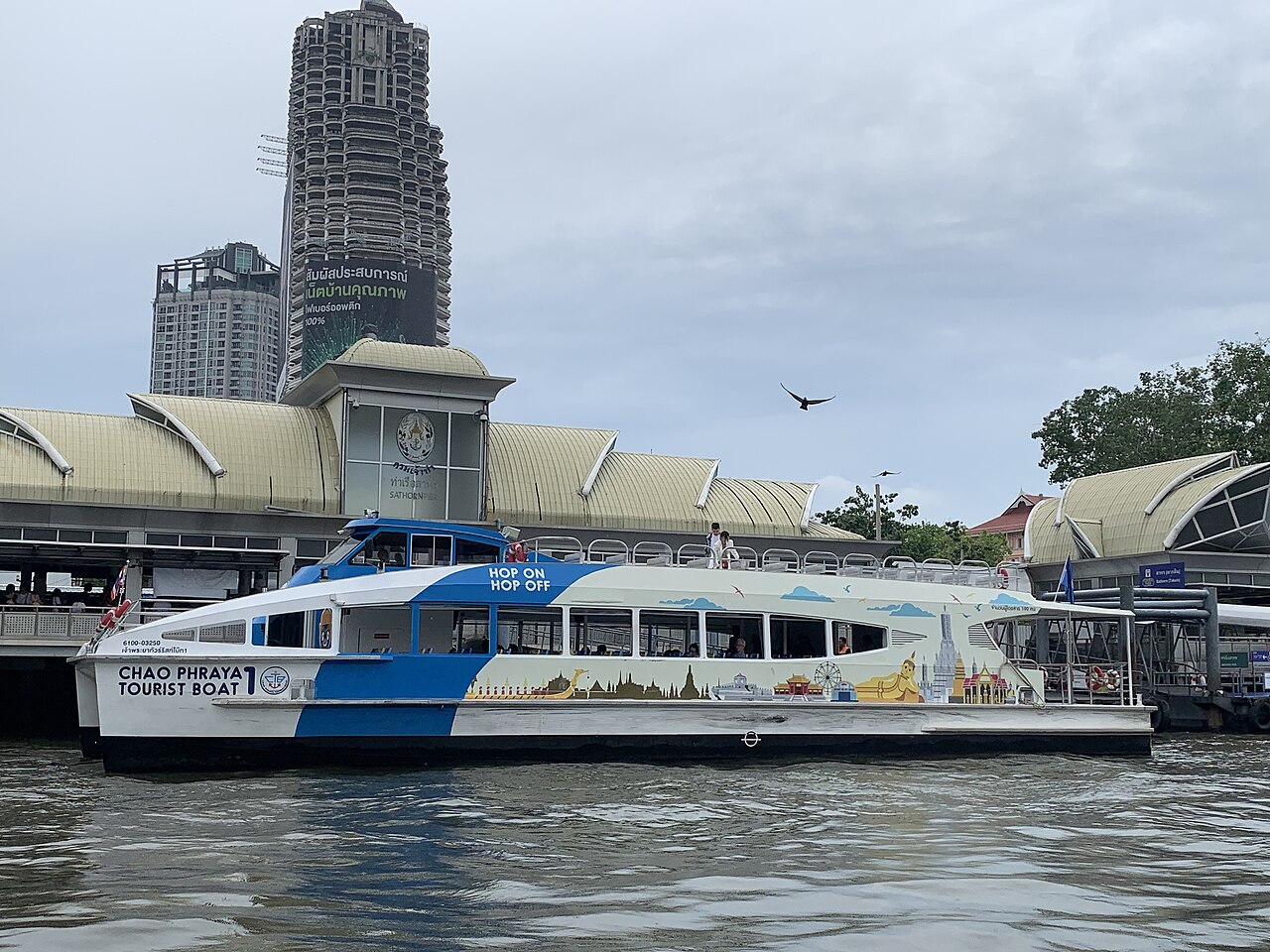
The blue-flag boat is not a scam. It runs every 30 minutes daily from about 08:30 to 19:40, it is covered and partly air-conditioned, the staff speak English, and it stops at Wat Arun and Asiatique, which the commuter lines do not. Buy the day pass at 150 baht and the arithmetic is simple: at 40 baht a single, you break even on your fourth ride. Three stops or fewer and you have paid for a ride you did not take.
Against the public boats, the pass is 150 baht versus about 20 a hop. Four hops on the orange flag come to 80 baht. The pass costs 70 baht more for the same day, and buys you commentary, a fixed 30-minute headway and the Wat Arun stop. Some travellers will call that money well spent. Most Thailand budget travel is knowing which one you are.
Two cheap boats nobody sells you
The cross-river ferry, about 5 baht. Squat chugging shuttles cross the river all day at a dozen points — Tha Tien to Wat Arun, Tha Chang to Wang Lang, and others. You drop coins in a turnstile or hand them to a collector, get no ticket, and cross in three minutes. It is the cheapest scheduled transport in Bangkok and the standard way to reach Wat Arun without a tourist boat ticket.
The Khlong Saen Saep canal boat, 16–26 baht. Fares rose to this band on 24 April 2026. The boats are loud, splash, and require you to duck under a rope at each stop, and they cut straight across the city’s worst traffic from Panfa Leelard, near Khao San Road and the Golden Mount, through Pratunam to Asok. In gridlock they beat a 200-baht taxi by twenty minutes. One ticket covers a transfer between the two lines at Pratunam.
A Bangkok river day, priced three ways
Two people staying near Sathorn, doing the Grand Palace, Wat Pho, Wat Arun and dinner near Khao San:
| How you travel | Cost for two | Notes |
|---|---|---|
| Public boats: 3 express hops + 2 ferry crossings each | 140 THB | About 70 THB a head |
| Blue-flag tourist day pass | 300 THB | Commentary, Wat Arun stop included |
| Grab or taxi, four legs | 600–1,000 THB | Plus the traffic on Ratchadamnoen |
| Private long-tail charter, two hours | 2,400–6,000 THB | The quote you get at the hotel desk |
The gap between the commuter boat and the car is about 660 baht for a couple, on one day, for a journey that is faster on the water. Do two river days in a fortnight and the public boats have saved you roughly 1,300 baht — four nights of beer money, or two decent hotel upgrades, depending on your priorities.
Getting to the pier, and the rest of your numbers
Sathorn (Central) pier sits at the foot of BTS Saphan Taksin, so the river network plugs straight into the skytrain for 17–62 baht. Arriving travellers reach it the same cheap way they reach everything else: Suvarnabhumi airport transit on the Airport Rail Link costs 15–45 baht to Phaya Thai against 400–600 baht by taxi, which we break down in our Suvarnabhumi airport transit guide.
Two small Thailand travel tips make the boats work. Buy a local SIM card Thailand’s operators sell at arrivals — AIS and TrueMove tourist packages run 299–599 baht — because pier names and timetables live on your phone. And eat at the piers: cheap food in Bangkok around Tha Tien and Wang Lang starts at 50–60 baht a plate, against 300 at a riverside restaurant with the same view. Those two habits, repeated, are what sets your average cost per day Thailand-wide; our five cities compared by daily cost piece puts the rest side by side.
Bottom line: your savings summary
- Same river, different boat: about 20 THB on the orange flag against 40 THB on the tourist boat. 20 THB saved per hop, per person.
- The 150-THB day pass: worth it from the fourth ride, not before. Three stops or fewer and you have overpaid by 30 THB or more.
- Wat Arun: the cross-river ferry at about 5 THB does what a 40-THB tourist-boat hop does.
- A couple’s river day: 140 THB on public boats against 600–1,000 THB by car — roughly 660 THB kept, and faster.
- Weekend reality check: midday and weekends it is the yellow flag at 23–25 THB, not the orange at 20. Budget for the higher number.
Thailand budget travel on the Chao Phraya comes down to one habit: look at the flag before you look at the boat. The 20-baht ride and the 40-baht ride leave from the same pontoon, minutes apart, and nobody at the pier is going to point out the difference.
Bangkok river boats: quick answers
How much is the Chao Phraya Express Boat in 2026?
The orange flag runs a flat fare in the 18–20 baht range, the yellow flag 23–25, the air-conditioned red flag 32–34, and the green-yellow flag 16–37 by distance. Fares move by 1–2 baht through the year with the diesel price — they rose on 7 April 2026, were cut on 1 May and rose again on 25 May — so the board at the pier is the only authority.
Is the Chao Phraya tourist boat worth 150 baht?
Only from the fourth ride. Singles are 40 baht, so a 150-baht day pass breaks even at four hops. It buys English commentary, a covered air-conditioned deck, a fixed 30-minute service from about 08:30 to 19:40 daily, and stops at Wat Arun and Asiatique that the commuter boats do not make.
What is the cheapest way to get to Wat Arun?
Take any express boat to Tha Tien pier, then the cross-river ferry for about 5 baht. The crossing takes roughly three minutes and runs from early morning to mid-evening. The temple’s own admission is charged separately at the gate.
Do Bangkok river boats take cards?
No. Pay cash, either to the conductor with the metal coin tube on board or at the pier kiosk. Carry coins and small notes; the cross-river ferries in particular want exact change and issue no ticket.
Is the canal boat cheaper than a taxi in Bangkok?
Usually, and faster in traffic. Khlong Saen Saep fares run 16–26 baht by zone after the 24 April 2026 increase, against 150–250 baht for a short taxi or app car across the same ground. One ticket covers the transfer between the two lines at Pratunam.
Work out what this costs you
Rules and fees change; your budget should keep up. Estimate your Thailand trip budget — flights, rooms, food and transport in baht and your own currency, in about two minutes.
Build my Thailand budget →Sources
Reporting this piece draws on. Rules change — check the primary source before you act on anything here.
- The Nation - Chao Phraya and Saen Saep boat fares to rise again on 7 April
- The Nation - Chao Phraya Express Boat fares to rise by 1 baht from 25 May
- Thaiest - Chao Phraya Express Boat map, timetable and fares by flag
- Thaiest - orange flag boat route, weekday-only hours and current fare
- Thaiest - Khlong Saen Saep canal boat fares after the 24 April 2026 rise
- Thaiest - Bangkok cross-river ferry crossings, piers and fares
- Thailandboat - Chao Phraya Express Boat and blue-flag tourist boat ticket prices
Published 25 September 2026. Travel rules, fees and prices change without much warning — always confirm with an official source or your embassy before you book or travel. Nothing here is legal, immigration or financial advice.